
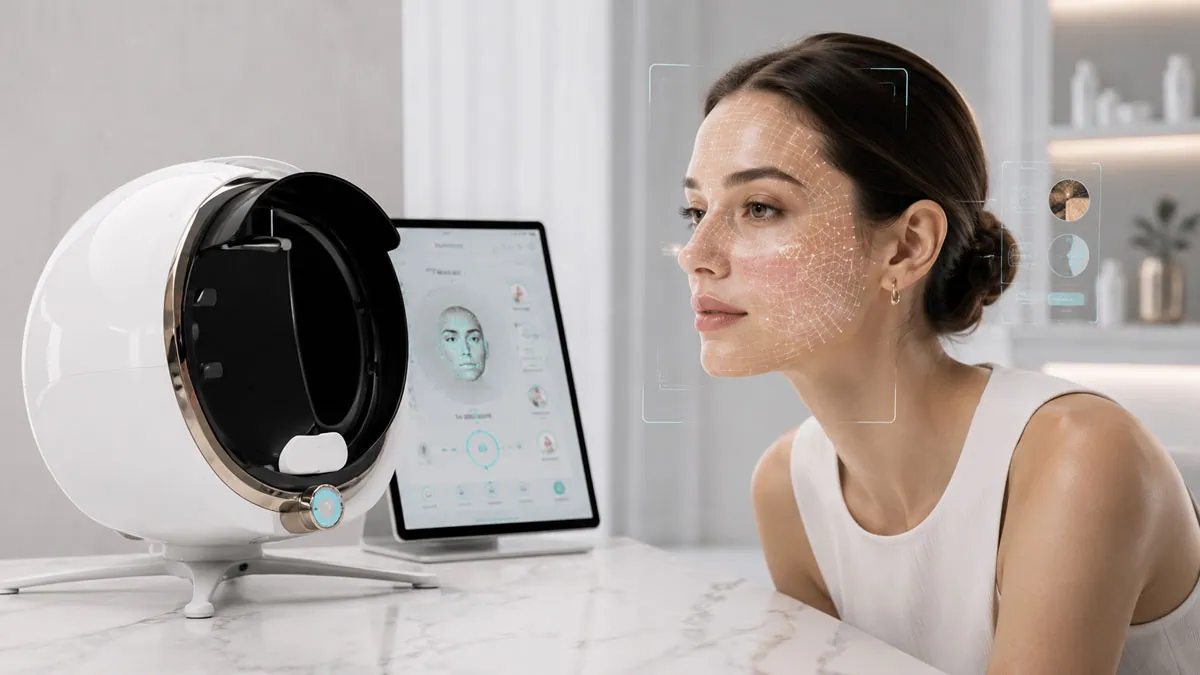
3D skin analysis in Marbella adds something useful to an aesthetic consultation: data that can actually be seen and compared. Instead of relying only on a mirror, memory or a quick visual impression, digital facial scanning creates a structured image of the skin that can help identify areas worth examining more closely and support a more personalised treatment plan.
At FBS Beauty, 3D/AI diagnostic scanning is used as an additional assessment tool during consultation. It can support facial and skin evaluation, visual comparison and treatment planning. It does not replace professional judgement, and it certainly does not turn a computer into a dermatologist. Think of it as a very observant digital assistant that never says, “I think your skin looked about the same last month.”
A 3D/AI skin scanner captures standardised digital images of the face and uses image-analysis software to map visible skin characteristics. Depending on the analysis mode, software can highlight differences in texture, pores, pigmentation patterns, lines and other visual features. The useful part is not simply receiving a score: the images can be reviewed during consultation, compared over time and interpreted together with the client's actual concerns.
Digital capture
Standardised facial images provide a more consistent visual reference than casual photographs taken under different lighting.
Software analysis
Image-processing tools help map visible patterns and divide the face into areas that can be examined more closely.
Personalised planning
The results can support discussion of priorities rather than choosing treatments simply because they are currently popular.
What is a 3D/AI skin analysis scanner?
A professional skin scanner is essentially a combination of controlled facial imaging, specialised software and a visual reporting system.
The device captures the face in a consistent position and under controlled conditions. The software then analyses the images and creates visual maps or measurements that can make certain features easier to see and compare.
The term AI skin analysis sounds futuristic, but the practical idea is straightforward. Algorithms examine patterns within facial images, separate different areas and organise the information into a format that can be reviewed during consultation.
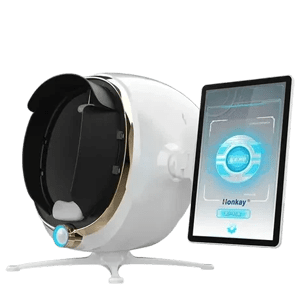
The scanner used for digital assessment at FBS Beauty
The scanning unit combines facial image capture with a dedicated display and software interface. During assessment, the client is positioned consistently in relation to the imaging system so that the resulting images can be reviewed under controlled conditions.
This consistency matters. A bathroom mirror at 8:00 in the morning, a selfie beside a window and a photograph under strong bathroom lighting can make the same skin look surprisingly different. A dedicated scanner reduces some of that visual variability.
How does 3D skin analysis work?
Although the software interface may look complex, the basic workflow can be understood in four stages.
The face is placed in a consistent position relative to the imaging system.
The scanner records high-detail facial images under controlled conditions.
Software examines visual patterns and creates maps or categories for review.
The results are discussed in relation to the client's actual skin concerns and goals.
The fourth stage is particularly important. A computer-generated result is not useful simply because it contains colourful maps and graphs. The question is what those findings mean for the person sitting in front of the screen.
What can digital skin scanning help assess?
Digital imaging can help make different aspects of the skin easier to examine. The exact parameters available depend on the equipment and software configuration, so not every skin-analysis system should be assumed to measure exactly the same things.
Skin texture
Unevenness and surface patterns can be visualised more consistently than with an ordinary mirror.
Visible pores
Areas where pores appear more prominent can be mapped and compared across facial zones.
Lines and wrinkles
Digital imaging can help document visible lines and follow how their appearance changes over time.
Pigmentation patterns
Differences in visible colour and pigmentation can be highlighted for closer assessment.
Facial symmetry
Digital images can make left-to-right differences easier to discuss during aesthetic planning.
Change over time
Repeat scans can provide a more useful visual comparison than relying on memory alone.
Why is controlled imaging better than ordinary before-and-after photos?
Before-and-after photographs can be useful, but only when the conditions are reasonably consistent. Different lighting, camera distance, facial expression, makeup or angle can make a surprising difference.
Digital scanning is designed to reduce some of those variables by using a repeatable imaging environment. That does not make every comparison perfectly scientific, but it can make visual follow-up more structured.
Digital skin scan
Consistent positioning, dedicated imaging, software-assisted comparison and organised visual results.
Regular phone photo
Useful for general documentation, but lighting, angle, camera processing and distance can change significantly between photographs.
What does the AI actually do?
Artificial intelligence in aesthetic imaging should not be treated as a mysterious machine that knows everything about your skin.
In practical terms, AI-assisted image analysis can help identify visual patterns, organise image data, compare areas of the face and present findings in a structured way.
That can make a consultation faster and more visual. Instead of saying, “There seems to be some uneven texture here,” the specialist and client can look at the same image and discuss the same area.
Processing images consistently, highlighting patterns and organising large amounts of visual information.
Replace professional assessment, diagnose every skin condition from a photograph or automatically decide which aesthetic treatment a person needs.
Seeing the results: where the scan becomes useful
The scan itself is only the first part. The useful moment comes afterwards, when the images and results are reviewed together.
A visual report can help answer practical questions: Where is the texture most uneven? Are the client's concerns concentrated in one area or spread across the face? Which issues appear to be priorities? Which findings are relatively minor and may not require aggressive treatment?
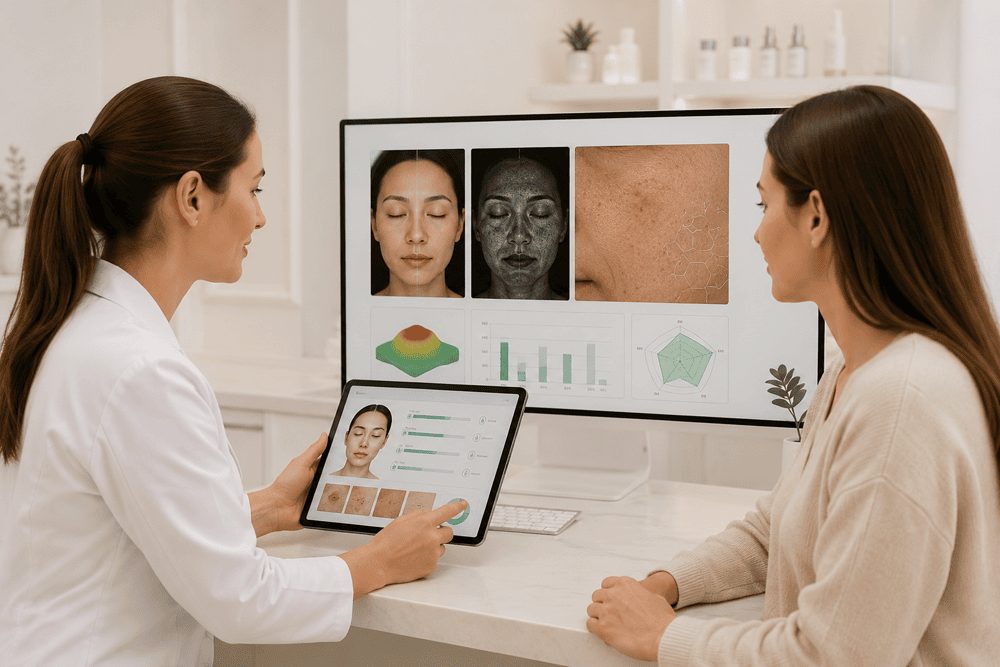
From skin scan to personalised treatment plan
The most useful question after a scan is not “What treatment does the machine recommend?” It is “What are we actually trying to improve?”
A scan may reveal several visible characteristics at the same time. That does not mean every finding requires a procedure.
Identify priorities
The client's main concern is compared with what can actually be seen in the images.
Separate the problems
Texture, pigmentation, laxity and volume loss are different problems and may require different approaches.
Choose the appropriate level
A skincare recommendation, regenerative protocol or energy-based procedure should match the actual objective.
Plan follow-up
Future images can help determine whether the skin is changing in the intended direction.
Can a skin scanner tell you which treatment you need?
Not by itself.
Software may organise findings or generate suggestions, but aesthetic treatment selection requires context. Age, medical history, previous procedures, skin sensitivity, downtime preferences, anatomy and expectations all matter.
For example, visible uneven texture and deeper facial laxity may appear in the same person, but they are not the same problem. One might relate more closely to skin-quality treatments, while the other may require a technology designed for deeper structural support.
A useful scan therefore narrows the conversation. It should not replace the conversation.
3D skin analysis before RF, laser or regenerative treatments
Digital assessment can be particularly useful when several treatment directions are being considered.
If the main concern is texture, visible pores or selected acne scars, our guide to RF microneedling in Marbella explains how radiofrequency is delivered through microneedles for controlled dermal remodelling. If deeper laxity is the priority, the Ultraformer MPT technology guide explains how focused ultrasound works at different tissue depths. If the goal is skin recovery and overall skin quality, regenerative approaches may also enter the conversation.
The point of scanning is not to make every client a candidate for more procedures. In some cases it may help show that the problem is relatively mild and that a simpler plan makes more sense.
Can digital scanning track treatment results?
This is one of the most practical uses of repeatable digital imaging.
When scans are performed before treatment and again later under similar conditions, they can create a visual record that supports comparison over time.
This is useful because human memory is not particularly good at remembering small gradual changes. When improvement develops over several months, a client may become accustomed to the new appearance and forget the original starting point.
Use repeat scans to support comparison, not to manufacture dramatic “before and after” effects through different lighting, facial expressions or camera angles.
What a 3D/AI skin scanner cannot tell you
Digital assessment is valuable precisely when its limitations are understood.
- It cannot diagnose every dermatological disease from an image.
- It cannot replace medical evaluation when a suspicious lesion or active skin disease is present.
- It cannot guarantee how an individual will respond to an aesthetic procedure.
- It cannot determine the best treatment from one numerical score alone.
- It cannot measure every biological process taking place inside the skin.
- It should not turn a minor cosmetic variation into a “problem” simply because software can assign it a number.
Numbers can be useful, but skin is still skin — not a school exam where 100/100 is the objective.
Is a higher skin score always better?
Not necessarily.
Different analysis systems can use different scoring methods and reference data. A score is therefore most useful within the context of the same system and the same person rather than as an absolute measure of “good” or “bad” skin.
For follow-up, a change in the images and the client's actual experience may be more meaningful than chasing one perfect number on a screen.
What happens during a 3D skin analysis consultation?
The process is non-invasive and primarily involves imaging and discussion.
You explain what you actually want to improve.
The face is positioned in the imaging system and digital images are captured.
The visual results are examined together rather than simply handed over as a score.
Relevant treatment or skincare directions can then be discussed.
Do you need to prepare for the scan?
Because the purpose is to assess the skin visually, it is useful for the face to be as unobstructed as possible during imaging.
Heavy makeup or products that dramatically change surface shine can affect how the skin appears in photographs. The exact preparation can be explained before the scan depending on how the assessment is being performed.
Is 3D/AI skin analysis a medical diagnosis?
No. An aesthetic digital skin assessment and a medical dermatological diagnosis are not the same thing.
A scanner can provide useful images and organise visual information, but suspicious moles, changing lesions, persistent rashes, infections or other medical concerns should be assessed through an appropriate medical pathway.
Keeping that distinction clear makes the technology more useful, not less useful.
Why use 3D skin analysis at FBS Beauty Marbella?
FBS Beauty uses digital scanning during consultation to support facial and skin assessment, visual comparison and more personalised planning.
This approach fits particularly well when several treatment options are available. Rather than beginning with a machine and trying to find a reason to use it, the better order is:
- understand the client's concern;
- look at the skin objectively;
- identify the main priorities;
- select the most relevant treatment direction;
- compare progress when follow-up imaging is useful.
Digital assessment is only the starting point. Once the main concern has been identified, you can explore the relevant treatment technology in our RF microneedling guide or Ultraformer MPT guide. Current treatment pricing is available on the FBS Beauty price list.
Frequently asked questions about 3D/AI skin analysis
What is 3D skin analysis?
3D skin analysis uses specialised facial imaging and software to create a structured digital assessment of the face and skin. Images can be processed to highlight different visual characteristics and facial zones. The results can then be reviewed during consultation and compared with the client's concerns. It is best regarded as an assessment and planning tool rather than a standalone medical diagnosis.
What does AI skin analysis actually analyse?
AI-assisted software can examine patterns within facial images and organise them into visual categories or maps. Depending on the particular system and analysis mode, this may include characteristics such as texture, visible pores, pigmentation patterns or lines. Exact parameters vary between devices, so one scanner should not automatically be assumed to have the same capabilities as another. The results also require interpretation rather than being accepted blindly.
Is AI skin analysis accurate?
Digital imaging can provide a more standardised visual reference than casual photographs, but accuracy depends on the camera system, lighting, software, positioning and what is being measured. AI does not make the result infallible. It is particularly useful for identifying and comparing visual patterns. A professional still needs to decide whether those patterns are actually relevant to the client's concern.
Can a skin scanner detect pigmentation?
Digital facial imaging can help highlight differences in visible pigmentation and colour distribution. Some professional skin-analysis systems also use specialised imaging modes to examine features that are difficult to appreciate under ordinary room lighting. However, the exact capabilities depend on the specific equipment. A digital image should not replace medical assessment when a pigmented lesion itself is suspicious or changing.
Can it analyse pores?
High-detail facial imaging can make visible pores easier to map and compare across different areas of the face. This can be useful when discussing skin texture and monitoring change. It does not mean that pores are abnormal structures or that every visible pore needs treatment. The purpose is to provide information, not to invent problems that the client did not have before seeing the screen.
Can it show wrinkles and fine lines?
Digital imaging can document visible lines and make their distribution easier to compare. Standardised positioning is useful because ordinary photos can look quite different depending on angle and light. Facial expression also affects the appearance of many lines, so interpretation still matters. A scan is therefore a visual reference rather than a perfect measurement of biological ageing.
Does the scanner tell me my skin age?
Some skin-analysis software can generate age-related estimates or comparison scores, but these should not be confused with a precise biological measurement of skin age. Such scores depend on the software model and the variables included in the calculation. They can be interesting as part of a consultation but should not become the sole reason for choosing treatment. A person's aesthetic goals and actual skin condition remain more important.
Can AI choose my treatment automatically?
It should not. Software can help organise information and may generate suggestions, but aesthetic planning requires more than image recognition. Medical history, anatomy, previous procedures, sensitivity, expectations and acceptable downtime also matter. At FBS Beauty, digital scanning is used to support personalised planning rather than replace professional judgement.
Is the scan painful?
No needles or energy-based treatment is required simply to create the digital assessment. The process primarily involves positioning the face and capturing images. There is therefore no treatment-style recovery period from the scan itself. Any later aesthetic procedure discussed after the assessment has its own separate comfort and recovery profile.
How long does the scan take?
Image capture itself is generally only one part of the appointment. The more valuable part is reviewing what has been captured and discussing which findings are actually relevant. The total consultation therefore depends on the questions being addressed and whether several treatment directions are being compared. FBS Beauty can confirm the current consultation format when booking.
Can I use a scan to track my results?
Yes, repeat digital imaging can support visual comparison over time when scans are performed under reasonably consistent conditions. This can be particularly useful for gradual changes that are difficult to remember accurately. It should not be used to manufacture dramatic differences through altered lighting or positioning. The value comes from consistency and context.
Should I scan my skin before RF microneedling?
A digital assessment can be useful when texture, pores or other visible skin-quality concerns are part of the reason for considering RF microneedling. It may help document the starting point and clarify priorities. However, the scan alone cannot determine whether RF microneedling is appropriate. Treatment suitability still depends on the skin, medical considerations and the specific objective.
Can it help choose between RF, laser and HIFU?
It can support the discussion by helping visualise some of the problems being considered, but these technologies work at different depths and through different mechanisms. Texture, pigmentation, dermal firmness and deeper facial laxity are not the same issue. A scan can help organise what is visible, while professional assessment determines which treatment direction best matches the concern.
Do I need a skin scan if I already know which treatment I want?
Not every client needs extensive digital analysis before every procedure. However, scanning can be useful when several concerns overlap or when an objective baseline would help with follow-up. It can also reveal that the treatment originally requested does not directly address the main visible issue. The purpose is to improve decision-making, not add technology merely for the sake of technology.
Can a 3D skin scanner diagnose skin cancer or skin disease?
An aesthetic 3D/AI facial scan should not be used as a substitute for medical dermatological assessment. Suspicious lesions, changing moles, persistent rashes, infections or other medical skin concerns require an appropriate professional evaluation. The scanner is primarily useful for digital aesthetic assessment and visual comparison. Keeping these roles separate is important for responsible use of the technology.
Where can I get 3D skin analysis in Marbella?
FBS Beauty offers digital 3D/AI scanning as part of its personalised assessment approach in central Marbella. The centre is located at Av. Ricardo Soriano, 54, 29601 Marbella, Málaga. The scan can support discussion of facial and skin concerns, comparison and treatment planning. Contact FBS Beauty to confirm the current consultation format and availability.
Start with the question rather than the machine. Tell FBS Beauty what you would like to improve, and digital skin analysis can be used where it adds useful information to the consultation and treatment plan.
This guide describes the general principles of professional digital and AI-assisted skin assessment. Exact imaging modes, software measurements and available parameters depend on the specific device and configuration. Digital skin scanning is intended to support visual assessment and aesthetic planning and does not replace medical dermatological diagnosis.