
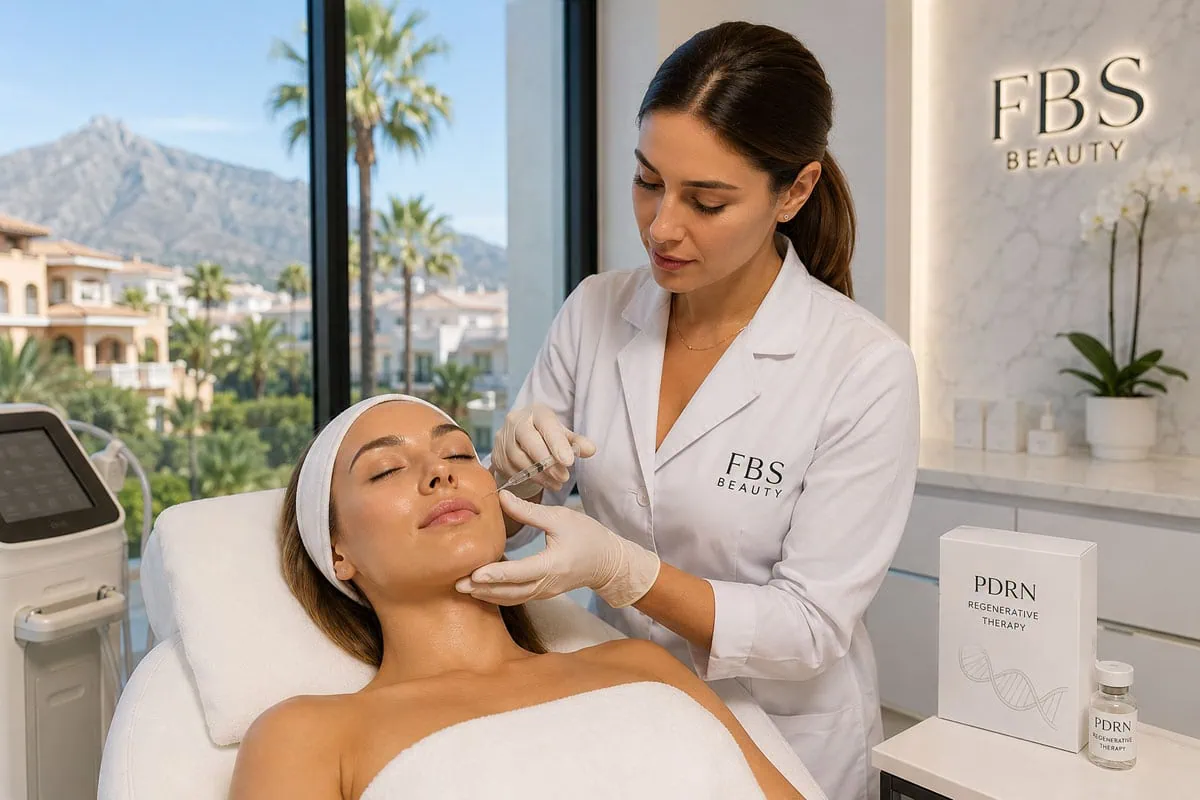
PDRN therapy in Marbella is part of a growing regenerative approach to aesthetic skin care that focuses not only on visible signs of ageing, but also on supporting the biological processes involved in repair and renewal. PDRN — polydeoxyribonucleotide — has attracted increasing attention for its potential role in tissue repair, skin-quality improvement and recovery after selected aesthetic procedures.
PDRN is a purified mixture of DNA-derived fragments studied for its role in tissue repair and regenerative processes. In aesthetic medicine, PDRN skin therapy in Marbella may be considered as part of a skin-quality, rejuvenation or post-procedure recovery programme. Research has explored mechanisms involving adenosine A2A receptor signalling and the nucleotide salvage pathway. PDRN is not an instant facelift: its role is primarily associated with supporting skin repair and quality, and results depend on the formulation, treatment method, skin condition and individual protocol.
PDRN is used within protocols intended to support skin repair, quality and renewal rather than simply camouflage visible changes.
PDRN is increasingly discussed as part of recovery strategies following selected controlled aesthetic procedures.
Skin condition, previous procedures and treatment goals should determine whether PDRN is an appropriate option.
What is PDRN?
PDRN stands for polydeoxyribonucleotide. It refers to purified DNA-derived fragments that have been investigated in regenerative medicine and tissue-repair research.
Scientific interest in PDRN is connected with biological pathways involved in tissue repair, inflammation and cellular metabolism. Earlier research concentrated largely on wound healing and damaged tissues, while applications within regenerative aesthetics have become increasingly visible in recent years.
For someone researching PDRN therapy in Marbella, this distinction is important. Social media sometimes presents regenerative treatments as if they can instantly reverse biological ageing. The scientific picture is more nuanced: PDRN has a developing evidence base around regenerative processes and skin quality, but results can vary according to formulation, delivery method and individual treatment protocol.
PDRN is frequently discussed alongside polynucleotides, PN treatments and the popular expression “salmon DNA”. These terms overlap in consumer language but should not automatically be treated as identical products. Molecular characteristics, purification, concentration and intended use can differ.
How does PDRN support skin repair?
Healthy skin repair is a complex biological process involving different cell types, inflammatory signals, blood vessels and components of the extracellular matrix. When skin is stressed or intentionally stimulated during an aesthetic procedure, these systems work together during recovery.
Research into PDRN has proposed two particularly interesting mechanisms: interaction with the adenosine A2A receptor and provision of nucleotide components through the salvage pathway.
Adenosine A2A receptor signalling
Adenosine receptors participate in multiple physiological processes, including regulation of inflammation and tissue responses. Experimental research suggests that PDRN-related activation of A2A receptor pathways may contribute to an environment favourable to tissue repair.
The nucleotide salvage pathway
Cells involved in repair require building materials for nucleic-acid synthesis. The salvage pathway allows nucleotide components to be reused rather than synthesised entirely from the beginning. PDRN-derived components have been investigated as a potential source supporting this process.
These mechanisms help explain why PDRN regenerative therapy is being investigated for skin repair and recovery. They do not mean that every PDRN product or every aesthetic protocol produces an identical result. A biological mechanism and a visible cosmetic outcome are not the same thing.
What can PDRN skin therapy be used for?
In aesthetic practice, interest in PDRN skin treatment is generally centred on skin quality, regeneration and recovery rather than dramatic structural transformation.
Skin quality
PDRN-based regenerative protocols may be considered when the objective is to support healthier-looking, more balanced skin.
Texture
Polynucleotide-based aesthetic research has reported potential improvements in skin texture and overall appearance in selected patients.
Elasticity
Some studies have reported changes in elasticity after polynucleotide treatments, although protocols and evidence quality vary.
Recovery
One developing application is the use of PDRN as part of recovery programmes following selected aesthetic procedures.
Hydration and comfort
A regenerative programme may also aim to improve the overall appearance and comfort of skin when barrier quality is part of the concern.
Anti-ageing programmes
PDRN may form one component of a broader personalised regenerative aesthetics strategy rather than being treated as the answer to every sign of ageing.
PDRN and post-procedure skin recovery
One of the most interesting areas of current research is the potential use of PDRN in post-procedure recovery in aesthetic medicine.
Procedures such as laser resurfacing, radiofrequency and microneedling intentionally create a controlled biological response. The purpose is to stimulate renewal, but the skin and underlying tissues then require time to recover.
Research has examined whether PDRN may support biological processes involved in repair, including re-epithelialisation, inflammatory regulation and tissue recovery. However, current aesthetic studies remain relatively small and use different formulations and treatment protocols.
PDRN should not automatically be applied after every laser, RF, peel, injection or ultrasound procedure. Correct timing depends on what treatment was performed, the condition of the skin barrier, the PDRN formulation and the individual recovery response.
Can PDRN be used after laser or RF treatments?
PDRN is increasingly discussed as a possible regenerative adjunct after procedures that rely on controlled tissue stimulation, including some laser and radiofrequency treatments.
That does not mean there is one universal rule such as “use PDRN immediately after every laser”. Ablative and non-ablative lasers behave differently, RF protocols differ, and combination procedures can affect different tissue depths.
When considering PDRN after laser treatment in Marbella, the important questions are what procedure was performed, whether the skin surface is intact, how strongly the tissues reacted and which PDRN protocol is being considered.
Regenerative aftercare should follow the biology of the procedure rather than a trend. The treatment that created the controlled tissue response and the recovery programme that follows it should form one coordinated plan.
PDRN after SMAS lifting or focused ultrasound
Focused ultrasound treatments such as Ultraformer MPT act at selected tissue depths without resurfacing the skin. Their recovery pattern is therefore different from laser resurfacing or microneedling.
If a patient is considering both SMAS lifting in Marbella and regenerative skin therapy, the treatments should be planned according to different objectives. Focused ultrasound is primarily associated with tissue tightening at deeper levels, whereas PDRN is more closely related to skin-quality and regenerative support.
One treatment should not automatically be presented as an “activator” of the other. A personalised sequence is more appropriate than stacking several technologies together simply because they are available.
Tell FBS Beauty which procedure you have recently had or are planning. The treatment sequence can then be considered according to your skin condition and individual goals.
PDRN vs polynucleotides: are they the same?
The terms PDRN and polynucleotides (PN) are frequently used together, which can make information about regenerative aesthetics confusing.
Both relate to nucleotide-based materials, but they should not automatically be treated as identical commercial products. Molecular size, processing, concentration, formulation and intended clinical use may differ.
| Term | What it generally means | Why it matters |
|---|---|---|
| PDRN | Polydeoxyribonucleotide preparations composed of purified DNA-derived fragments. | Formulation and molecular characteristics can influence how a particular product is used. |
| Polynucleotides / PN | A broader category of nucleotide polymers increasingly used in aesthetic skin-quality treatments. | Different products may use different molecular sizes, concentrations and protocols. |
| “Salmon DNA” | A simplified popular expression used in consumer marketing. | The term alone provides little information about purification, formulation, concentration or treatment method. |
PDRN vs exosomes: what is the difference?
PDRN and exosomes are both discussed within the rapidly developing field of regenerative aesthetics, but they represent different biological approaches.
PDRN
PDRN consists of purified DNA-derived nucleotide fragments. Research focuses on regenerative pathways including A2A receptor signalling and nucleotide salvage mechanisms.
Exosomes
Exosomes are extracellular vesicles involved in cell-to-cell communication. Their characteristics depend greatly on source, processing and formulation.
The useful question is therefore not simply “Is PDRN better than exosomes?”. They are different approaches and may be selected for different objectives or incorporated into different regenerative programmes.
At FBS Beauty, the broader Regenerative Aesthetics direction includes different approaches to skin renewal. The appropriate option depends on the individual condition of the skin and the desired result.
What does current research say about PDRN?
The research picture is promising but still developing.
PDRN has a scientific history in tissue-repair research that extends beyond its current popularity in aesthetic medicine. Experimental and clinical literature has examined wound healing, inflammation, angiogenesis and regenerative processes.
Systematic reviews of PDRN and tissue regeneration have identified biological mechanisms involving the nucleotide salvage pathway and adenosine A2A receptor activation.
Research focusing more specifically on polynucleotides in aesthetic medicine has reported promising findings involving wrinkles, texture and elasticity. At the same time, available studies are relatively limited, patient numbers are modest and treatment protocols vary.
PDRN should be described as promising rather than as a guaranteed rejuvenation treatment. The biological rationale is supported by a developing scientific literature, but aesthetic results depend on the product, treatment technique and individual patient. Responsible regenerative aesthetics combines current evidence with realistic expectations.
What results can you realistically expect?
PDRN should not be marketed as an instant facelift or as a replacement for treatments designed to correct substantial volume loss or significant tissue laxity.
Its role is more logically connected with the condition, appearance and recovery of the skin.
- Support for healthier-looking skin quality
- Potential improvement in skin texture
- Support for elasticity in appropriate protocols
- Regenerative support after selected procedures
- Gradual rather than dramatic improvement
- Integration into a wider anti-ageing programme
The exact response depends on age, skin condition, treatment indication, formulation, method of delivery, course length and other treatments being performed.
How is a PDRN treatment plan created?
A good regenerative programme begins with the question “What are we trying to improve?” rather than simply choosing the most fashionable product.
1. Assess the skin
Current skin condition, sensitivity, texture, hydration, barrier quality and previous treatments are considered.
2. Define the objective
Recovery, skin-quality improvement and anti-ageing support are different objectives and may require different approaches.
3. Choose the protocol
The treatment format and timing should be selected according to the individual situation rather than copied automatically.
4. Review the response
Skin response and progress should be evaluated before deciding whether additional treatment is appropriate.
How many PDRN sessions may be recommended?
There is no scientifically universal course that is correct for every PDRN formulation and every patient.
At FBS Beauty Marbella, the currently offered PDRN Regenerative Therapy programme recommends a course of 4–6 sessions. The final plan should still depend on the individual objective and response.
A course can be useful when the goal is gradual regenerative support rather than a single temporary cosmetic effect. More sessions, however, do not automatically mean proportionally better results.
PDRN therapy price in Marbella
At FBS Beauty, PDRN Regenerative Therapy in Marbella is currently listed at €120 per session.
| Programme | Price | Format |
|---|---|---|
| PDRN Regenerative Therapy | €120 | Single session |
| 4-session course | €440 | Course option |
| 6-session course | €630 | Extended course option |
Treatment prices and programme availability may change, so current conditions should be confirmed when booking.
PDRN and anti-ageing: what can it actually change?
Facial ageing is not a single process. Changes take place in the skin, fat compartments, supporting structures, muscles and bone.
PDRN is primarily relevant to the skin-quality and regenerative part of this picture. It does not physically reposition deep tissues, replace lost facial volume or stop biological ageing.
For this reason, PDRN skin rejuvenation in Marbella may be particularly interesting when the objective is to support texture, recovery and overall skin quality while preserving a natural appearance.
PDRN regenerative therapy at FBS Beauty Marbella
FBS Beauty is located in central Marbella at Av. Ricardo Soriano, 54.
PDRN therapy forms part of the centre's broader regenerative aesthetics direction. The objective is not to recommend the same procedure to every client, but to identify whether the priority is skin-quality improvement, recovery, lifting, pigmentation, barrier care or another aesthetic concern.
Individual assessment
Skin condition and previous aesthetic procedures are considered before selecting a regenerative protocol.
Combination planning
PDRN may form part of a broader programme rather than automatically being added to every other procedure.
Realistic goals
Regenerative therapy focuses on skin quality and repair support rather than unrealistic promises of permanent rejuvenation.
Central Marbella
Consultations and treatments are available at FBS Beauty on Avenida Ricardo Soriano in central Marbella.
Frequently asked questions about PDRN therapy in Marbella
What is PDRN therapy?
PDRN therapy uses polydeoxyribonucleotide-based preparations within regenerative or skin-quality protocols. PDRN consists of purified DNA-derived fragments studied for biological processes involved in tissue repair. In aesthetic medicine, the objective is generally to support skin quality and recovery rather than create dramatic structural lifting. A specific PDRN therapy Marbella protocol should therefore be selected according to skin condition and individual goals.
What does PDRN do for the skin?
Research has explored PDRN in relation to tissue repair, inflammation and regenerative processes. In aesthetic applications, polynucleotide treatments have been investigated for skin texture, elasticity and overall appearance. Results vary according to formulation and treatment technique, and the evidence continues to develop. PDRN skin treatment in Marbella should therefore be considered part of an individual regenerative plan rather than a guaranteed transformation.
Is PDRN the same as salmon DNA?
“Salmon DNA” is a simplified consumer expression often used when discussing PDRN and polynucleotide treatments. Some preparations are derived from highly purified DNA from salmonid species, but the popular term does not describe the actual formulation. Purification, molecular characteristics and concentration matter. When considering PDRN regenerative therapy in Marbella, it is better to ask about the real treatment protocol rather than rely on a marketing nickname.
Is PDRN the same as polynucleotides?
The terms overlap but are not necessarily identical. PDRN is a polydeoxyribonucleotide preparation, while polynucleotides can refer more broadly to nucleotide polymers used in regenerative aesthetic products. Different formulations may have different molecular characteristics and intended applications. Findings from one product therefore cannot automatically be applied to every PDRN or PN treatment.
Is PDRN better than exosomes?
PDRN and exosomes are different biological approaches, so there is no universal answer that one is simply better. PDRN involves purified DNA-derived fragments, whereas exosomes are extracellular vesicles involved in cellular communication. They may address overlapping regenerative objectives but are not interchangeable. At FBS Beauty Marbella, the appropriate regenerative direction should be selected according to the skin condition and treatment goal.
Can PDRN help after laser treatment?
Post-procedure recovery is one of the areas being investigated for PDRN. Research discusses a potential role in biological processes associated with tissue repair following controlled aesthetic procedures. However, suitability and timing depend on the type of laser, skin condition and treatment method. PDRN after laser treatment in Marbella should therefore be coordinated with the professional responsible for the laser procedure.
Can PDRN be used after RF or microneedling?
PDRN and polynucleotide-based treatments are also discussed in relation to recovery after radiofrequency and microneedling procedures. These treatments can differ significantly in depth and intensity. A regenerative protocol should take into account the degree of controlled tissue stimulation and the stage of recovery. Timing should therefore be personalised rather than copied from another treatment protocol.
Can PDRN be combined with Ultraformer MPT?
PDRN and Ultraformer MPT address different aspects of aesthetic treatment. Ultraformer MPT uses focused ultrasound for tissue tightening, while PDRN is more closely associated with skin quality and regenerative support. Both may form part of a broader anti-ageing plan, but they do not have to be performed together. Treatment sequence should depend on anatomy, skin condition and individual goals.
How many PDRN sessions do I need?
There is no universal number of sessions appropriate for every patient or formulation. At FBS Beauty Marbella, the current PDRN Regenerative Therapy programme recommends a course of 4–6 sessions. The final number should depend on the reason for treatment and how the skin responds. More sessions do not automatically guarantee a better result.
How much does PDRN therapy cost in Marbella?
The current listed price for PDRN therapy at FBS Beauty Marbella is €120 per session. A four-session course is listed at €440 and a six-session course at €630. Prices and programmes can change, so current conditions should be confirmed before booking. FBS Beauty is located at Av. Ricardo Soriano, 54 in Marbella.
Does PDRN have downtime?
Downtime depends on the treatment method and whether PDRN is used alone or alongside another procedure. A non-invasive regenerative protocol and an injectable polynucleotide treatment cannot automatically be expected to have the same recovery profile. Temporary redness or sensitivity may also be associated with another procedure performed at the same time. Ask what technique will be used during your individual PDRN treatment in Marbella.
When will I see results from PDRN?
Regenerative skin treatment should generally be viewed as gradual rather than instant. Visible changes depend on the initial skin condition, treatment protocol and whether PDRN is used alone or within a combination programme. Skin quality may develop progressively during a treatment course. Consistent before-and-after photographs are often more useful for evaluating gradual changes than daily mirror checks.
Can PDRN remove wrinkles?
Polynucleotide research has reported potential improvements in wrinkle-related measures, but PDRN should not be described as a treatment that removes every wrinkle. Wrinkles can result from muscle activity, structural ageing, volume changes, sun exposure and reduced elasticity. Different causes require different approaches. PDRN skin rejuvenation is more appropriately associated with skin quality and regenerative support.
Does PDRN stimulate collagen?
Research involving PDRN and polynucleotides discusses fibroblast activity and tissue-remodelling pathways associated with collagen. However, saying that a treatment “stimulates collagen” does not guarantee a specific amount of new collagen or a predictable lifting result. Laboratory mechanisms and visible aesthetic outcomes are different levels of evidence. Expectations should therefore remain realistic.
Who is a good candidate for PDRN therapy?
PDRN may be considered when the primary objective involves skin quality, regenerative support or recovery after selected aesthetic procedures. Suitability depends on skin condition, medical history, recent treatments, formulation and treatment method. It is not automatically appropriate for every pigmentation problem, active skin condition or structural ageing concern. An individual assessment is the correct starting point for PDRN therapy in Marbella.
Where can I get PDRN therapy in Marbella?
FBS Beauty offers PDRN Regenerative Therapy in Marbella as part of its regenerative aesthetics direction. The centre is located at Av. Ricardo Soriano, 54, 29601 Marbella, Málaga. A single PDRN session is currently listed at €120, with course options also available. Contact FBS Beauty to discuss your goals and confirm current treatment availability.
This article is based on published scientific literature concerning PDRN, polynucleotides, tissue repair and regenerative aesthetics. Current research includes different formulations, treatment methods and patient groups, so findings from one study cannot be guaranteed for every aesthetic protocol.
The article provides general educational information and does not replace individual professional assessment.
Considering PDRN skin therapy in Marbella?
Tell the FBS Beauty team what you would like to improve, whether you have recently had another aesthetic procedure and what type of result you prefer. An individual consultation can help determine whether PDRN regenerative therapy or another skin-renewal direction is appropriate.