
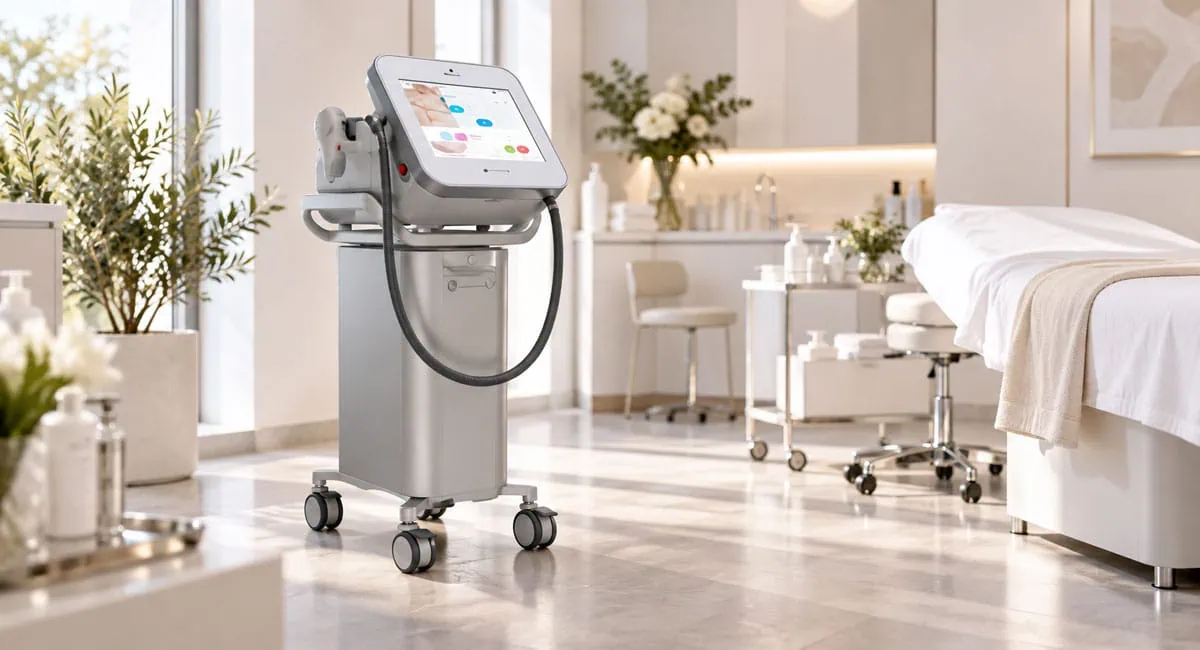
LightSheer DESIRE technology is based on an 805 nm diode laser designed for professional hair reduction across different face and body areas. What makes the platform technically interesting is not only the wavelength itself, but the way LightSheer DESIRE combines three dedicated handpieces, different spot sizes, adjustable pulse widths, vacuum assistance and ChillTip contact cooling to adapt treatment to different areas and hair characteristics.
A laser hair removal session may look simple from the outside: the handpiece touches the skin, a pulse is delivered and the operator moves to the next area. In reality, several variables matter at the same time — wavelength, fluence, pulse duration, spot size, cooling, hair colour, hair thickness, skin characteristics and the phase of the hair-growth cycle.
LightSheer DESIRE is an 805 nm diode-laser platform used for long-term hair reduction. Laser energy is absorbed by melanin in the hair shaft and follicular structures and converted into heat. The goal is to create enough selective thermal damage in actively growing follicles to reduce future hair growth while limiting unnecessary heating of the surrounding skin. The platform uses three handpieces — HS, XC and ET — with different spot sizes and comfort technologies for large, small and precision treatment areas.
805 nm diode laser
A wavelength widely used in professional laser hair reduction because it targets melanin while reaching follicular structures below the skin surface.
Three handpieces
HS, XC and ET provide different spot sizes and treatment approaches for large, small and precision areas.
Vacuum assist
The HS handpiece uses vacuum-assisted technology and a large treatment window for faster coverage of larger areas.
ChillTip cooling
XC and ET use sapphire contact cooling to protect the epidermis and improve comfort during higher-fluence precision treatment.
What exactly is LightSheer DESIRE?
LightSheer DESIRE is a professional laser platform from Lumenis. It belongs to the LightSheer family of diode-laser systems and uses nominal 805 nm diode laser energy.
The system is designed for permanent hair reduction and can be configured for different anatomical areas through several handpieces. Rather than treating a small facial area and a full leg with exactly the same treatment window and energy strategy, LightSheer DESIRE allows the operator to choose a handpiece that better matches the size and precision requirements of the area.
This is important because laser hair reduction is not simply about using “the strongest possible setting”. The treatment needs enough energy to affect the follicular target while respecting the thermal tolerance of the surrounding skin.
LightSheer DESIRE is a single 805 nm diode-laser platform with several ways to deliver that energy. The handpiece, spot size, pulse duration, fluence and comfort technology are selected according to the area, skin and hair characteristics rather than being identical for everyone.
Why does LightSheer DESIRE use three different handpieces?
The three handpieces are one of the most useful ways to understand the platform. They are not simply three cosmetic shapes of the same tool. Each has a different treatment window and a different comfort-management approach.
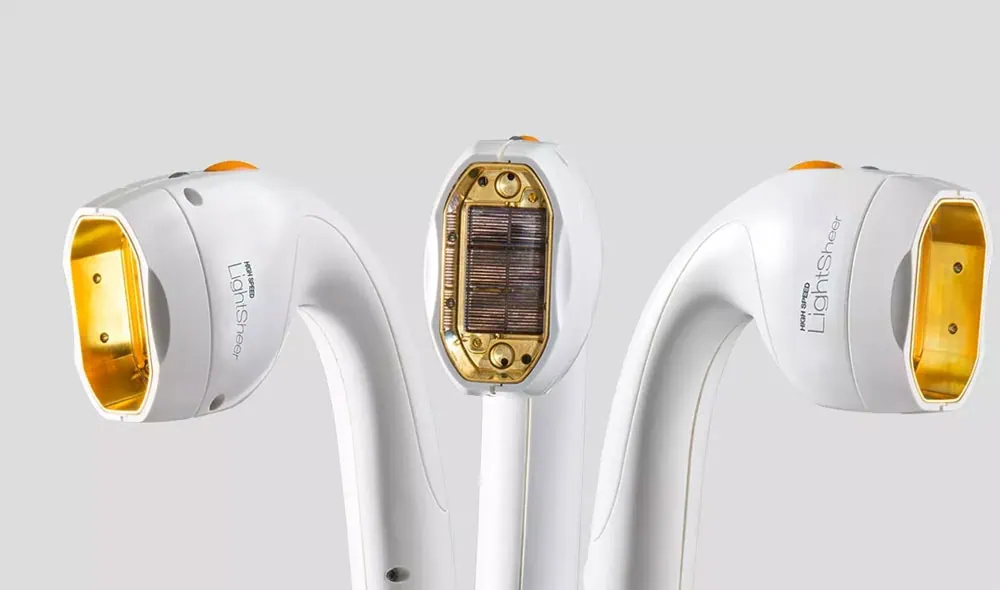
| Handpiece | Approx. spot size | Comfort technology | Typical role |
|---|---|---|---|
| HS | 22 × 35 mm | Vacuum assist | Fast coverage of large body areas using a large treatment window and lower-fluence strategy. |
| XC | 12 × 12 mm | Sapphire ChillTip contact cooling | Versatile treatment of medium and smaller areas where precision and higher fluence may be useful. |
| ET | 9 × 9 mm | Sapphire ChillTip contact cooling | Small or anatomically precise areas requiring a compact treatment window. |
HS handpiece: why use vacuum for laser hair reduction?
The HS handpiece combines an unusually large 22 × 35 mm treatment window with vacuum-assisted High-Speed Integrated Technology.
During treatment, vacuum draws the skin into the handpiece. This changes the geometry of the treatment area: follicles are brought closer to the laser source, tissue is compressed, and the optical path through the skin is altered.
Lumenis describes the HS approach as a way to use lower fluence while maintaining effective treatment of larger areas. The large spot size also means fewer individual placements are needed to cover areas such as legs, back or other broad body regions.
Vacuum does not “pull the hair out” and it does not remove the follicle mechanically. Its purpose is to modify tissue position and optical conditions during laser delivery.
XC and ET handpieces: what does ChillTip do?
XC and ET use a sapphire contact-cooling system known as ChillTip. The cooled sapphire surface remains in contact with the skin before and during laser delivery.
The purpose is twofold: it helps protect the epidermis from excessive heat and can make higher-fluence precision treatment more comfortable.
The XC handpiece offers a larger precision window than ET, while ET is designed for compact areas where placement needs to be particularly controlled.
This difference is useful around areas such as the underarms, bikini line, face or other smaller zones where the operator may prefer a smaller treatment window than the HS handpiece.
How does an 805 nm diode laser actually affect a hair follicle?
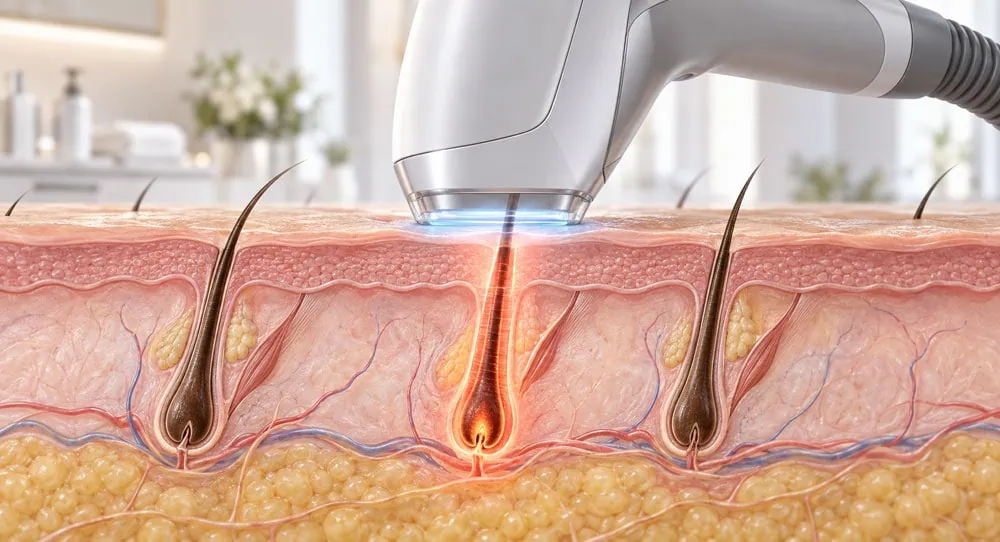
Laser hair reduction is based on selective absorption of light.
Hair contains melanin, the pigment that gives it colour. When an appropriate wavelength reaches a pigmented hair, part of the optical energy is absorbed by melanin and converted into heat.
The aim is not merely to heat the visible hair above the skin. The clinically relevant target is the follicular structure beneath the surface, where heat can disrupt cells involved in continued hair production.
What is selective photothermolysis?
The principle is often described as selective photothermolysis: light of an appropriate wavelength is absorbed by a target chromophore, converted into heat, and delivered for a duration that allows the target to receive meaningful thermal damage without heating all surrounding tissue equally.
In laser hair reduction, melanin is the key chromophore. This is why darker, coarser hairs typically provide a clearer optical target than white, grey or very lightly pigmented hairs.
Selectivity is not created by wavelength alone. Fluence, pulse duration, spot size, cooling and skin pigmentation also influence the treatment.
Why 805 nm?
LightSheer DESIRE uses a nominal 805 nm diode wavelength. This wavelength sits in a range commonly used for professional hair reduction because it provides a practical balance between melanin absorption and penetration into the skin.
A shorter wavelength may be absorbed more strongly by superficial melanin, while a longer wavelength penetrates differently and may interact with other tissue chromophores. An 805 nm diode laser is therefore not simply “stronger” than another wavelength; it represents a particular balance of optical properties.
This is also why treatment settings still need to be adjusted to the individual. Skin melanin competes for some of the same optical energy that the hair target absorbs.
Why does skin colour matter if the laser is targeting hair?
Melanin is present not only in hair but also in the epidermis. When the skin contains more melanin — naturally or because of recent tanning — more laser energy may be absorbed near the surface.
This is one reason operators consider skin characteristics when selecting fluence and pulse duration, and why recent tanning should be discussed before a session.
LightSheer systems are designed for use across a wide range of skin types, but “usable on different skin types” does not mean every skin type should receive identical settings.
Why are fluence and pulse duration important?
Two treatments can use the same wavelength and still behave very differently if their fluence and pulse duration are different.
Fluence
Fluence describes the amount of laser energy delivered per unit area. It influences how much thermal energy reaches the target.
Pulse duration
Pulse width determines how quickly that energy is delivered and how heat has time to spread through the target and surrounding tissue.
LightSheer DESIRE allows different parameter ranges depending on the handpiece. That flexibility matters because a fine facial hair, a coarse underarm hair and a dense male back are not identical optical targets.
Why does spot size matter?
Spot size affects both treatment speed and optical behaviour.
A larger treatment window covers more area with each placement. This is particularly valuable for legs, back and other broad regions.
A smaller treatment window gives the operator more control around limited or anatomically curved areas.
Spot size is therefore not a simple “bigger is better” specification. The correct size depends on the treatment zone and the delivery technology being used.
Why can't one session remove every hair?
Hair follicles do not all grow in synchrony.
Individual follicles cycle through active growth, transition and resting phases. Laser hair reduction is most useful when a sufficiently pigmented hair is actively connected to the structures that need to receive the thermal effect.
At any one appointment, only a proportion of hairs in a treatment area will be in the most responsive phase. Other follicles may enter active growth later.
This is the biological reason a course is required. Repeating a session too soon does not force resting follicles to become treatable; sessions need to be spaced around the growth pattern of the area.
What happens to the hair after treatment?
A treated hair does not necessarily disappear the moment the laser pulse is delivered.
Over the following days and weeks, successfully treated hairs may loosen and shed. They can sometimes appear to be “growing” because the hair shaft is being pushed outward before it releases.
Between sessions, shaving is normally compatible with the treatment plan because it removes hair above the skin without pulling the follicular target out from the root.
Waxing, tweezing or epilating is different: these methods physically remove the hair from the follicle and therefore remove the pigment-rich target that the next laser session needs.
Why are dark, coarse hairs usually easier to treat?
The more melanin a hair contains, the clearer the optical target tends to be.
Coarse dark hair usually contains much more pigment than very fine blond hair. That difference helps explain why two people can follow the same appointment schedule yet respond differently.
Hair colour, shaft diameter, density and depth all influence the response.
What about blond, red, grey or white hair?
Very lightly pigmented hair is more difficult because there is less melanin available to absorb diode-laser energy.
Grey and white hairs may contain too little useful pigment for conventional melanin-targeting laser hair reduction to work effectively.
Red and very blond hair can also be less predictable than dark hair. This is not a failure of a specific brand; it is a limitation created by the optical target itself.
LightSheer DESIRE for underarms
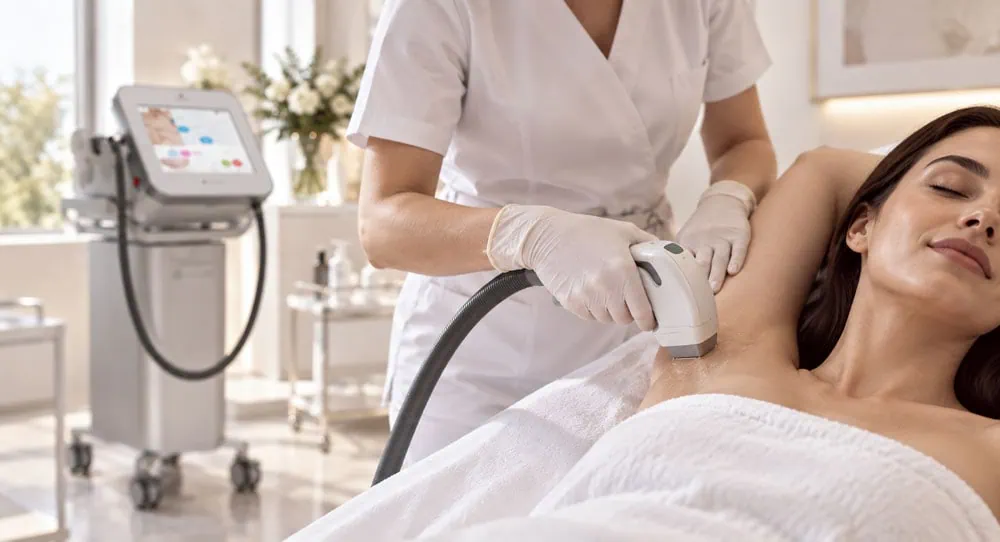
Underarms are a common laser-hair-reduction area because the hair is often relatively coarse and pigmented, while the zone itself is compact enough for precise handpiece placement.
The selected handpiece and parameters depend on the person's skin characteristics, hair density and previous treatment response.
Which areas can LightSheer DESIRE treat?
The three-handpiece design allows treatment to be adapted to both small and large areas.
Small facial areas
Upper lip, chin, beard contour and other compact zones require controlled placement and careful parameter selection.
Medium areas
Underarms, bikini line and arms can be treated with a handpiece selected for the size and precision of the area.
Large body areas
Legs, back, chest and abdomen benefit from efficient coverage, particularly when a larger treatment window is appropriate.
LightSheer DESIRE versus IPL: are they the same?
No. Laser and IPL can both be used for hair reduction, but they are different light technologies.
LightSheer DESIRE
Uses an 805 nm diode laser wavelength and dedicated laser handpieces with defined spot sizes and pulse parameters.
IPL
Uses a broad spectrum of filtered intense pulsed light rather than one laser wavelength.
Whether a specific system is appropriate depends on the target, skin, hair and device settings. The useful distinction is technological, not simply that one label sounds more advanced.
LightSheer DESIRE versus other diode lasers
Many professional hair-removal systems use diode technology, so “diode laser” alone does not describe the complete treatment experience.
LightSheer DESIRE is differentiated by its established 805 nm platform, three-handpiece architecture and two different comfort strategies: vacuum assistance with HS and ChillTip contact cooling with XC and ET.
Other diode systems may use different wavelengths, multiple wavelengths, different cooling methods or different treatment-window designs.
The most meaningful comparison therefore includes not only wavelength, but also spot size, pulse control, cooling, operator technique and appropriate settings.
What does LightSheer DESIRE treatment feel like?
Sensation varies by treatment area, hair density, handpiece and selected parameters.
With ChillTip handpieces, the skin is in direct contact with a cooled sapphire surface. With the HS handpiece, the client may notice the vacuum action as the skin is drawn into the treatment chamber.
Laser pulses may be perceived as brief warmth, snapping or tingling. More intense sensation does not automatically mean a more effective treatment.
Treatment should use settings appropriate for the target and the skin, rather than chasing the highest possible fluence.
How to prepare for a LightSheer DESIRE session
- Do not wax, tweeze or epilate the treatment area during the period advised before the session.
- Shave the area according to the instructions provided by the clinic.
- Tell the specialist about recent sun exposure or tanning.
- Mention medications or products that may increase photosensitivity.
- Avoid applying irritating products to sensitive treatment areas immediately before the appointment.
- Discuss active skin irritation, infection or recent procedures before treatment.
Why is shaving allowed before laser hair removal?
Shaving cuts the hair at the skin surface but leaves the follicular target in place.
This is different from waxing or tweezing, which removes the hair shaft and root structure that carries the pigment needed for laser absorption.
A freshly shaved area can also reduce unnecessary heating of long hair above the skin surface.
What happens after a session?
Temporary redness, warmth or perifollicular swelling can occur after laser hair reduction. The degree of visible reaction varies with the area, hair density, skin sensitivity and treatment settings.
The skin should be treated gently after the session. Strong heat, friction, aggressive exfoliation and intense sun exposure may need to be avoided according to the treatment plan.
Follow the aftercare advice provided by the specialist because recommendations may differ by area and individual skin response.
How many LightSheer DESIRE sessions are usually needed?
There is no single number that applies to every person.
FBS Beauty currently explains to clients that a course may often involve approximately 5–10 sessions, but this is a planning range rather than a guarantee. The exact number depends on area, hair colour and thickness, skin characteristics, natural growth cycles and individual response.
The first interval may often be around four to six weeks, with later gaps adjusted according to the speed of new growth in the area.
A better strategy is to review the course as it progresses rather than deciding in advance that every client requires exactly the same number of appointments.
Why can maintenance sessions be needed?
Laser hair reduction is designed to produce a long-term reduction in hair growth, but biology continues after the initial course.
Hormonal changes, age, genetics and previously inactive follicles can influence new or renewed hair growth over time.
Maintenance does not necessarily mean the original course “failed”. It can reflect ongoing biological changes in a living hair-growth system.
Can laser hair removal be completely permanent?
The more accurate term is permanent hair reduction, not a promise that every hair in a treated area will disappear forever.
A successful course may significantly reduce the number, density and speed of regrowing hairs. Remaining hairs may become finer or less noticeable.
Individual results vary, and hormonal or biological changes can influence future growth.
When LightSheer DESIRE may be less effective
A sophisticated laser still depends on a suitable optical target.
- White and grey hairs may contain too little melanin for effective targeting.
- Very fine blond hair may respond less predictably than coarse dark hair.
- Recent tanning can alter the safety margin because epidermal melanin is increased.
- Hair that has been removed from the root shortly before treatment provides less target pigment.
- Hormonal stimulation can continue to influence future hair growth even after a successful course.
What LightSheer DESIRE does not do
- It does not guarantee 100% permanent removal of every hair.
- It cannot make white or completely non-pigmented hair a strong melanin target.
- It does not eliminate the need for appropriate settings for different skin and hair types.
- It does not make tanning irrelevant to treatment planning.
- It does not replace medical evaluation when sudden excessive hair growth may have an underlying hormonal or medical cause.
- Higher fluence is not automatically better or safer.
LightSheer DESIRE at FBS Beauty Marbella
At FBS Beauty, LightSheer is used for professional diode-laser hair reduction on selected face and body areas. Treatment planning considers the chosen zone, skin characteristics, hair structure and the expected course rather than applying one universal setting to everyone.
If you want practical information about treatment areas, preparation, current prices and booking, visit the Laser Hair Removal in Marbella service page.
You can also review the detailed laser hair removal price guide or the current FBS Beauty price list.
This article explains how the LightSheer DESIRE platform works. The commercial treatment page covers the practical client questions: which areas are available, how a course is planned, current prices and how to book.
Frequently asked questions about LightSheer DESIRE
What is LightSheer DESIRE?
LightSheer DESIRE is a professional diode-laser platform from Lumenis. It uses a nominal 805 nm wavelength and is designed for permanent hair reduction and other approved laser indications. The platform includes three hair-removal handpieces with different spot sizes. Its treatment approach can therefore be adapted to large body areas, medium zones and small areas requiring greater precision.
What wavelength does LightSheer DESIRE use?
The LightSheer DESIRE platform uses a nominal 805 nm diode-laser wavelength. This wavelength is widely used for hair reduction because it can be absorbed by melanin in pigmented hair while penetrating to follicular structures below the skin surface. Wavelength is only one part of the treatment. Fluence, pulse duration, spot size, cooling and individual skin and hair characteristics also matter.
How does LightSheer DESIRE remove hair?
Laser energy is absorbed by melanin in the hair and converted into heat. The thermal effect is transferred to follicular structures involved in continued hair growth. When a follicle receives sufficient controlled thermal damage during the appropriate growth phase, future growth from that follicle can be reduced. This is why the treatment produces progressive hair reduction rather than instant removal of every hair.
What are the three LightSheer DESIRE handpieces?
The platform includes HS, XC and ET handpieces. HS uses a large 22 × 35 mm treatment window and vacuum assistance for efficient coverage of larger areas. XC uses a medium sapphire ChillTip window and is useful for versatile precision treatment. ET uses a compact 9 × 9 mm ChillTip window for smaller areas where controlled placement is especially important.
What is the HS vacuum handpiece?
The HS handpiece uses vacuum-assisted High-Speed Integrated Technology. Vacuum draws the skin into the handpiece and changes the optical geometry during the laser pulse. The large 22 × 35 mm treatment window allows broad areas to be covered efficiently. The vacuum itself does not pull hair follicles out; it supports the way laser energy is delivered.
What is ChillTip?
ChillTip is Lumenis contact-cooling technology used with the XC and ET handpieces. A cooled sapphire surface is placed directly against the skin before and during laser delivery. This helps protect the epidermis from unnecessary heating and can reduce discomfort. It also allows precision treatment in areas where higher fluence may be appropriate.
Is LightSheer DESIRE suitable for dark skin?
LightSheer diode systems are designed for treatment across a broad range of skin types, but darker skin contains more epidermal melanin and therefore requires appropriate parameter selection. Skin type, recent tanning and treatment area should be assessed before a session. “Suitable for different skin types” does not mean that identical settings are used on every client.
Does LightSheer DESIRE work on blond or grey hair?
Response depends strongly on pigment. Dark coarse hair is generally a clearer laser target because it contains more melanin. Very light blond, grey and white hairs contain less useful pigment and may respond poorly or not at all to conventional melanin-targeting laser hair reduction. A consultation can help determine whether the hair provides a realistic target.
Why do I need several laser hair removal sessions?
Hair follicles cycle through different phases and are not all actively growing at the same time. Laser treatment is most useful when a pigmented hair is in the appropriate active growth phase. A later appointment treats additional follicles as they enter that phase. This is why a planned course is more effective than trying to complete treatment in one session.
How many LightSheer DESIRE sessions are usually needed?
FBS Beauty currently uses approximately 5–10 sessions as a general planning range, but the exact number is individual. Treatment area, hair colour and thickness, skin characteristics, hormonal influences and response all affect the course. The interval between sessions also changes according to the speed of regrowth. Progress should be reviewed during the course.
Can I shave between LightSheer sessions?
Shaving is normally compatible with a laser hair reduction course because it cuts the hair above the skin without removing the follicular target from the root. Waxing, tweezing and epilating physically remove the hair and are therefore usually avoided during the course. Follow the timing instructions given by the clinic for shaving before each appointment.
Does LightSheer DESIRE hurt?
Sensation varies by area, hair density, handpiece and settings. ChillTip handpieces provide direct sapphire cooling, while the HS handpiece uses a vacuum-assisted comfort mechanism. Clients may feel brief warmth, snapping or tingling during a pulse. Stronger discomfort is not a measure of better treatment.
Can LightSheer DESIRE treat underarms?
Yes. Underarms are a common treatment area because the hair is often relatively coarse and pigmented. The area is compact, so precise handpiece placement is useful. Settings should still be selected according to skin characteristics, hair density and previous response. FBS Beauty currently offers underarm laser hair reduction for both women and men.
Can I have LightSheer treatment after tanning?
Recent tanning should be discussed before treatment because tanning increases epidermal melanin. That can change how much laser energy is absorbed near the skin surface and may narrow the safety margin. The specialist may adjust timing or settings depending on the skin condition. It is better to disclose recent sun exposure than to assume it does not matter.
Is LightSheer DESIRE the same as IPL?
No. LightSheer DESIRE is an 805 nm diode laser. IPL uses a broad spectrum of filtered intense pulsed light rather than a single laser wavelength. Both technologies can be used for hair reduction, but their optical delivery and device design differ. Results depend on the actual system, parameters, target and operator technique rather than the category name alone.
Is LightSheer DESIRE permanent?
The technically accurate goal is permanent hair reduction rather than a guarantee that every hair disappears forever. A successful course can significantly reduce hair density, speed of regrowth and the need for frequent shaving. Hormonal and biological changes can still influence future growth. Some clients therefore choose occasional maintenance sessions.
Where can I have LightSheer laser hair removal in Marbella?
LightSheer laser hair removal is available at FBS Beauty in central Marbella at Av. Ricardo Soriano, 54, 29601 Marbella, Málaga. Treatment is available for selected facial and body areas, with separate price options for women and men. Before beginning a course, the area, skin characteristics and hair structure can be reviewed so that the treatment plan is realistic.
Tell FBS Beauty which areas you want to treat and what your previous hair-removal routine has been. The course can then be planned around your skin, hair characteristics and natural growth cycle rather than using one schedule for everyone.
This guide explains the technology and treatment logic of the LightSheer DESIRE platform for educational purposes. Exact settings, handpiece selection, fluence, pulse duration and treatment intervals depend on the area, skin characteristics, hair properties and professional assessment. Hair reduction varies between individuals, and very lightly pigmented hair may provide an insufficient optical target for conventional melanin-based laser treatment.