
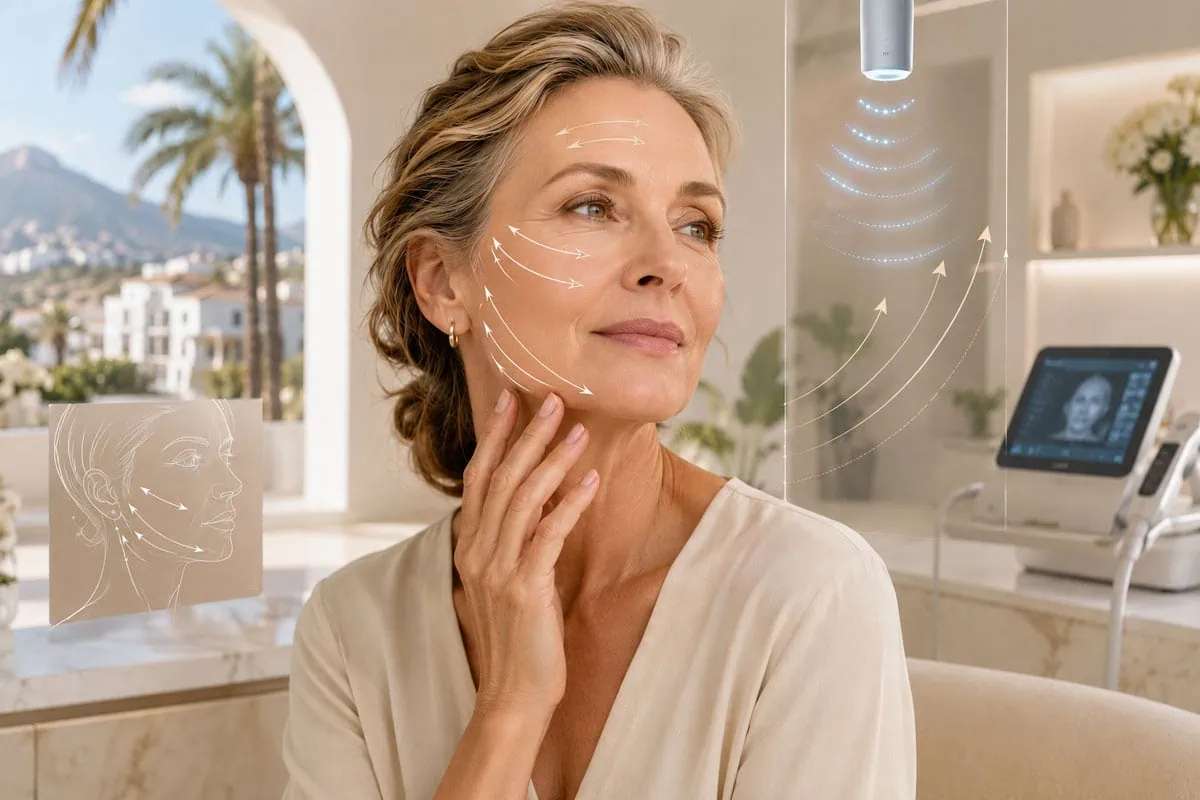
A deep plane facelift in Spain and non-surgical lifting in Marbella are very different approaches to facial ageing. One is an operation that repositions deeper facial tissues; the other uses focused ultrasound to support gradual firmness without incisions. Understanding this difference is essential before comparing results, recovery or cost.
A deep plane facelift may provide more substantial structural correction for significant facial and neck laxity, but it involves surgery, anaesthesia, incisions and a planned recovery period. Ultherapy and Ultraformer MPT are non-surgical focused-ultrasound treatments intended for more gradual and limited improvement. They cannot remove excess skin or reproduce a surgical facelift result.
A plastic surgeon works with deeper facial tissues through incisions and a formal operation.
Ultherapy or Ultraformer MPT may support gradual firmness and facial definition without surgery.
Suitability depends more on tissue condition and expectations than on age alone.
FBS Beauty is an advanced aesthetic centre in Marbella and does not perform deep plane facelift surgery. This guide is educational and explains how surgical lifting differs from the non-surgical treatments available at FBS Beauty.
What Is a Deep Plane Facelift?
A facelift, medically known as a rhytidectomy, is a surgical procedure intended to improve visible signs of ageing in the face and neck. The term “deep plane” describes an approach in which the surgeon works beneath the superficial musculoaponeurotic system, commonly called the SMAS.
Rather than relying mainly on tension placed on the skin, the operation aims to release and reposition deeper soft tissues. Depending on the individual plan, it may address the mid-face, jowls, jawline and neck.
The exact meaning of “deep plane facelift” can differ between surgeons because operative techniques are not completely uniform. Current research suggests that both deep plane and established SMAS approaches can provide strong outcomes, while the choice of technique should be matched to the person’s anatomy, concerns and surgeon’s expertise.
“Deep plane” should not automatically be interpreted as superior for every face. A qualified plastic surgeon must determine whether this technique, another facelift approach or no surgery at all is appropriate.
What Can Facelift Surgery Address?
Facelift surgery is usually considered when ageing changes are sufficiently pronounced that repositioning tissues and managing excess skin may be required.
Pronounced jowls
Surgery may reposition tissues that have descended around the lower cheeks and jawline.
Significant facial laxity
More advanced sagging may require structural correction rather than stimulation alone.
Loose neck skin
A surgical plan may include the neck when excess skin and deeper tissue changes are present.
Changes across several areas
Surgery may address the mid-face, lower face and neck within one coordinated plan.
A facelift does not stop ageing, correct every skin-texture concern or guarantee a particular appearance. It also cannot be assessed from photographs or age alone.
What Is Non-Surgical Lifting?
Non-surgical lifting describes aesthetic treatments intended to support firmness or definition without incisions. At FBS Beauty, the relevant options include focused-ultrasound treatments such as Ultherapy and Ultraformer MPT.
Focused ultrasound delivers controlled energy beneath the skin at selected depths. The aim is to support a gradual collagen-related response rather than physically remove skin or surgically reposition facial tissues.
Ultherapy
Microfocused ultrasound with real-time visualisation used for selected areas such as the brow, under-chin area, neck and décolleté.
Ultraformer MPT
A focused-ultrasound platform used for individualised non-surgical face, jawline and neck treatment plans.
These systems should not be described as a “facelift without surgery” if that phrase creates the impression that they produce the same structural correction as an operation.
Deep Plane Facelift in Spain vs Non-Surgical Lifting
| Factor | Deep plane facelift | Ultherapy or Ultraformer MPT |
|---|---|---|
| Type of treatment | Surgical operation | Non-surgical focused-ultrasound treatment |
| Incisions | Required | Not required |
| Anaesthesia | Part of the surgical plan | General anaesthesia is not required |
| Main action | Repositions deeper facial tissues and may manage excess skin | Supports a gradual tissue and collagen response |
| Degree of correction | Potentially substantial structural correction | More limited and gradual improvement |
| Recovery | Planned surgical recovery and follow-up | Usually minimal interruption to normal activities |
| Scarring | Incisions create scars, although placement is planned carefully | No surgical scars |
| Excess skin | May be addressed surgically | Cannot be removed |
| Result development | Visible after surgery but affected by swelling and healing | Develops gradually over the following weeks and months |
Who May Consider a Deep Plane Facelift?
Surgical consultation may be appropriate when facial or neck laxity is advanced enough that a non-surgical procedure is unlikely to meet the person’s goals.
- Pronounced jowls or lower-face sagging
- Significant loose skin around the face or neck
- A desire for more substantial structural correction
- Acceptance of incisions, scars and a recovery period
- Realistic understanding of surgical risks and limitations
- Suitability confirmed through a surgical assessment
The decision should be made with a properly qualified plastic surgeon after reviewing health history, anatomy, goals, risks and recovery requirements.
Who May Prefer a Non-Surgical Option?
Focused ultrasound may be considered when the concern is mild to moderate, the person prefers gradual change or surgery is not currently desired.
- Early or moderate reduction in skin firmness
- Concern about jawline or under-chin definition
- Mild laxity around the lower face or neck
- A preference for treatment without incisions
- Limited time available for recovery
- Realistic expectations about the degree of improvement
Surgery may be more appropriate when
- there is significant excess skin;
- tissues require substantial repositioning;
- the desired change exceeds what energy-based treatment can provide;
- the person accepts surgical recovery and risk;
- a qualified surgeon recommends an operative approach.
Focused ultrasound may be considered when
- changes are mild or moderate;
- a gradual result is acceptable;
- surgery is not desired;
- there is no need to remove excess skin;
- the treatment area is suitable after assessment.
Can Ultherapy Replace a Deep Plane Facelift?
No. Ultherapy and Ultraformer MPT cannot reproduce the tissue repositioning, excess-skin management or scale of correction possible with facelift surgery.
That does not make a non-surgical procedure ineffective. It means the treatment has a different purpose. For a person with early laxity, gradual skin tightening may match the actual concern more closely than surgery. For someone with advanced laxity, focused ultrasound may be too limited.
The question is not whether Ultherapy is “better” than a deep plane facelift. The question is which level of intervention matches the actual tissue condition, desired change and willingness to accept surgery.
What Does Surgical Recovery Involve?
When considering a deep plane facelift in Spain, recovery planning is just as important as choosing the surgical technique.
A deep plane facelift is a significant operation. Recovery may include dressings, swelling, bruising, discomfort, incision care and scheduled follow-up with the surgical team.
The timing of returning to work, exercise, travel and social activity varies. Residual swelling can remain after the initial visible recovery, so the final result is not judged immediately.
Anyone travelling to Spain for surgery should plan not only the procedure itself but also pre-operative assessment, safe accommodation, support during the early recovery period and access to the operating surgeon if concerns arise.
A holiday environment should not be confused with a recovery plan. Flights, heat, sun exposure, mobility, medication, follow-up and the possibility of complications must be discussed directly with the surgical provider.
What Are the Risks of Facelift Surgery?
All surgery carries risk. Potential facelift complications can include bleeding, infection, anaesthesia-related complications, fluid accumulation, poor wound healing, prolonged swelling, visible scarring, changes in sensation, asymmetry and temporary or permanent nerve-related effects.
This does not mean that every person will experience a complication. It means that risks must be discussed as part of informed consent and assessed against the expected benefit.
FBS Beauty cannot evaluate surgical suitability or provide surgical follow-up. Questions about a deep plane facelift must be directed to an appropriately qualified plastic surgeon and surgical facility.
Are Non-Surgical Treatments Risk-Free?
No aesthetic procedure should be described as completely risk-free. Focused-ultrasound treatments can produce temporary redness, swelling, tenderness, tingling or altered sensation. Less common effects should be discussed before treatment.
The recovery profile is generally different from surgery, but a personal assessment and correct treatment planning are still necessary.
Read the FBS Beauty guide to HIFU therapy, treatment areas, gradual results and realistic expectations.
View the HIFU Therapy GuideHow Should You Compare Your Options?
Define the real concern
Separate excess skin, tissue descent, loss of definition, volume change and surface texture concerns.
Decide how much change you want
A subtle gradual improvement and substantial structural correction are different goals.
Consider recovery honestly
Think about work, travel, social commitments, support at home and tolerance for surgical downtime.
Choose the correct consultation
Surgery must be assessed by a qualified plastic surgeon; non-surgical treatment requires an appropriate aesthetic assessment.
Questions to Ask Before Considering Surgery in Spain
Before arranging a deep plane facelift in Spain, ask the surgical provider clear questions about qualifications, facilities, risks, recovery and follow-up.
- Who will perform the operation, and what are their recognised qualifications?
- Where will the surgery take place, and is the facility appropriately authorised?
- What specific technique is being recommended, and why?
- What risks are most relevant to your health and anatomy?
- Who provides care if a complication occurs after you leave Spain?
- How long must you remain locally before travelling?
- What is included in the quoted price and follow-up plan?
- What result is realistic rather than guaranteed?
Anyone comparing a deep plane facelift in Spain with focused-ultrasound treatment should first decide whether the goal is substantial surgical correction or a more gradual non-surgical improvement.
Non-Surgical Lifting at FBS Beauty in Marbella
FBS Beauty provides non-surgical focused-ultrasound treatments for suitable clients who want to support facial firmness and definition without an operation.
Individual assessment
The face, jawline, under-chin area and neck are considered according to the actual tissue condition.
Realistic expectations
The limitations of non-surgical lifting are explained rather than compared with surgery through exaggerated promises.
Area-specific planning
Treatment areas and intensity are selected according to individual goals and suitability.
Gradual result development
Focused-ultrasound results are reviewed over time rather than judged only immediately after treatment.
Explore Ultherapy and Ultraformer MPT for non-surgical treatment of selected face, jawline and neck concerns in Marbella.
View Ultherapy & Ultraformer MPTFrequently Asked Questions
What is a deep plane facelift?
A deep plane facelift is a surgical facial-rejuvenation approach in which a plastic surgeon works beneath the SMAS layer to release and reposition deeper facial tissues.
Is a deep plane facelift better than a traditional facelift?
Not necessarily for every person. Surgical techniques differ, and the most suitable approach depends on anatomy, concerns, goals and the surgeon’s assessment and experience.
Can Ultherapy produce the same result as a facelift?
No. Ultherapy cannot remove excess skin or reproduce the structural tissue repositioning possible with surgery. It is intended for more limited and gradual non-surgical improvement.
Who may prefer non-surgical lifting?
It may be considered by people with mild or moderate firmness concerns who prefer gradual improvement, do not require excess-skin removal and do not currently want surgery.
Who may need a surgical consultation?
A surgical consultation may be appropriate when there is pronounced facial or neck laxity, significant excess skin or a desire for structural correction beyond the limits of focused ultrasound.
Does a deep plane facelift leave scars?
A facelift requires incisions and therefore creates scars. Their placement and appearance depend on the surgical plan, healing and individual factors.
How long is recovery after a deep plane facelift?
Recovery varies and occurs in stages. Swelling, bruising, incision care and restrictions may continue after the initial recovery, so timing must be discussed with the operating surgeon.
Is a deep plane facelift in Spain cheaper?
Prices vary widely and should not be compared without checking what is included, the surgeon’s qualifications, the facility, anaesthesia, aftercare and management of possible complications.
Does FBS Beauty perform facelift surgery?
No. FBS Beauty is an advanced aesthetic centre in Marbella and offers non-surgical treatments. It does not perform deep plane facelift operations.
What non-surgical lifting treatments are available at FBS Beauty?
FBS Beauty offers focused-ultrasound treatments including Ultherapy and Ultraformer MPT for suitable face, jawline, under-chin and neck concerns.
Can focused ultrasound remove loose skin?
Focused ultrasound may support firmness in suitable cases, but it cannot surgically remove excess skin.
How do I know which option is right for me?
The choice depends on the degree of laxity, desired change, health, recovery preferences and realistic expectations. Surgery requires assessment by a qualified plastic surgeon, while non-surgical treatment requires an individual aesthetic assessment.
Sources and further reading: this article uses general facelift information from the American Society of Plastic Surgeons , including its guidance on risks and safety and surgical recovery . Information about non-surgical ultrasound treatment is supported by official Ultherapy treatment guidance .
Related FBS Beauty Guides
Continue with detailed information about focused ultrasound, treatment suitability and non-surgical facial lifting in Marbella.
Considering a Non-Surgical Lifting Treatment in Marbella?
Discuss your face, jawline or neck concerns and receive realistic guidance about focused-ultrasound treatment at FBS Beauty.
Request a Consultation