
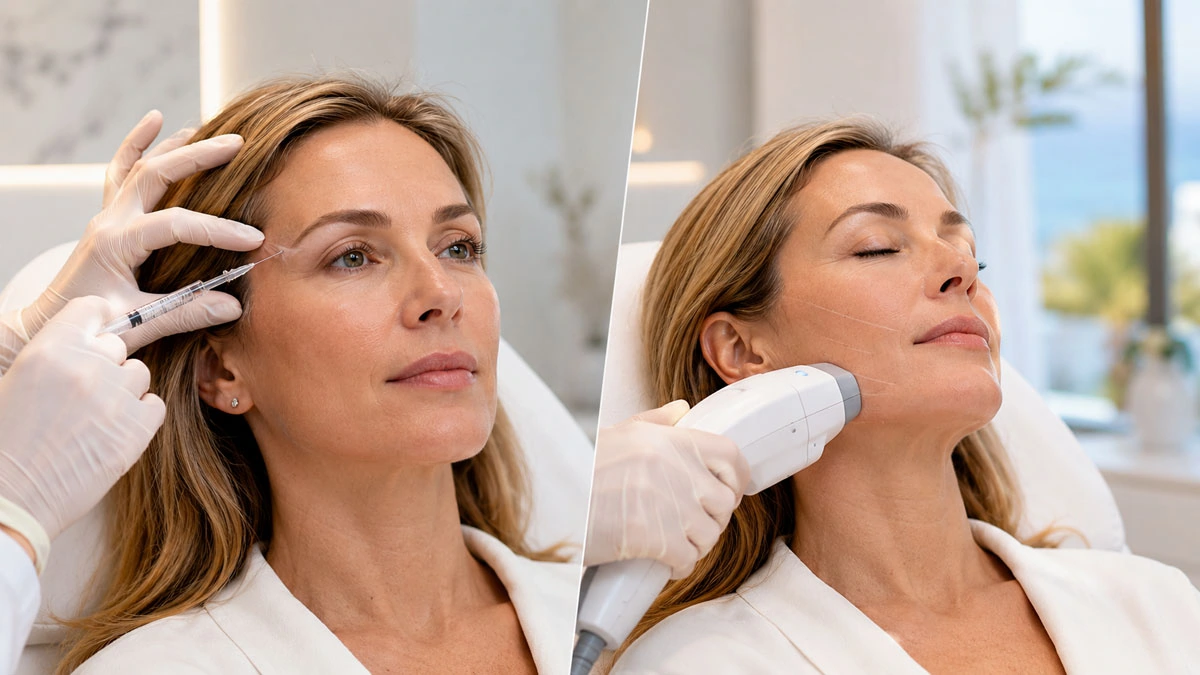
Botox vs Ultherapy is not a question of which treatment is “better” for everyone, but which one matches your main concern. Botox helps soften expression lines caused by repeated muscle movement, while Ultherapy / Ultraformer MPT uses focused ultrasound to support skin tightening and improve facial contours without surgery. If your main concern is sagging skin, jowls, jawline definition or neck laxity, Ultherapy may be more relevant than Botox after a medical consultation.
Quick answer: Botox vs Ultherapy
- Botox is mainly used for dynamic wrinkles — lines that appear when you smile, frown, squint or raise your eyebrows.
- Ultherapy / Ultraformer MPT is more relevant for mild to moderate skin laxity, especially around the jawline, neck, jowls and lower face.
- Botox does not tighten the SMAS layer or lift sagging tissue; it works by temporarily relaxing selected facial muscles.
- Ultherapy does not replace Botox for active expression lines, because it does not relax the muscles that create those lines.
- In some cases, Botox and Ultherapy can complement each other, but the plan should depend on facial anatomy, skin condition and medical consultation.
- At FBS Beauty in Marbella, Dr. Olga Semenova can assess whether your concern is mainly muscle-related wrinkles, skin laxity, volume loss or a combination of factors.
What is the main difference between Botox and Ultherapy?
The main difference is the target: Botox works with muscle activity, while Ultherapy works with deeper tissue support and skin laxity. Botox is commonly used to soften expression lines, and Ultherapy / Ultraformer MPT is used when the concern is sagging skin, loss of firmness, jawline definition or neck laxity.
Botox is an injectable treatment that temporarily relaxes selected facial muscles. These muscles create dynamic wrinkles — lines that appear when you frown, smile, squint or raise your eyebrows. This is why Botox is often used for forehead lines, frown lines between the eyebrows and crow’s feet around the eyes.
Ultherapy / Ultraformer MPT uses focused ultrasound energy instead of injections. The energy is delivered below the skin surface to support collagen renewal and tissue tightening over time. One of the key reasons patients consider this type of treatment is its ability to work with deeper support layers, including the SMAS area, which is important for facial firmness and contour.
This is why Botox and Ultherapy should not be seen as direct competitors. They are different tools for different signs of aging. If your concern is mainly expression lines, Botox may be more relevant. If your concern is sagging skin, jowls, jawline softness or neck laxity, Ultherapy may be the more suitable treatment to discuss during a consultation.
When is Botox the better option?
Botox may be the better option when the main concern is expression lines caused by repeated facial movement. These are wrinkles that become more visible when you smile, frown, squint or raise your eyebrows.
Botox is commonly used for areas where muscle activity creates visible lines over time. The goal is not to change the structure of the face, but to soften the movement that contributes to these wrinkles. When performed carefully, the result should look refreshed rather than frozen.
Common areas treated with Botox
Botox is often considered for:
- forehead lines;
- frown lines between the eyebrows;
- crow’s feet around the eyes;
- fine expression lines caused by repeated muscle movement.
For example, if a patient in Marbella is mainly concerned about forehead wrinkles or lines around the eyes, Botox or anti-wrinkle injections may be more relevant than Ultherapy. In this case, the problem is not sagging tissue, but repeated muscle contraction.
However, Botox has clear limits. It does not tighten loose skin, lift the jawline, improve jowls or work on the SMAS layer. If the face looks tired because of sagging skin, neck laxity or loss of lower-face definition, Botox alone may not address the main concern.
For additional patient-oriented information, the American Academy of Dermatology explains how botulinum toxin therapy is used for expression-related wrinkles such as frown lines and crow’s feet.
When is Ultherapy more relevant?
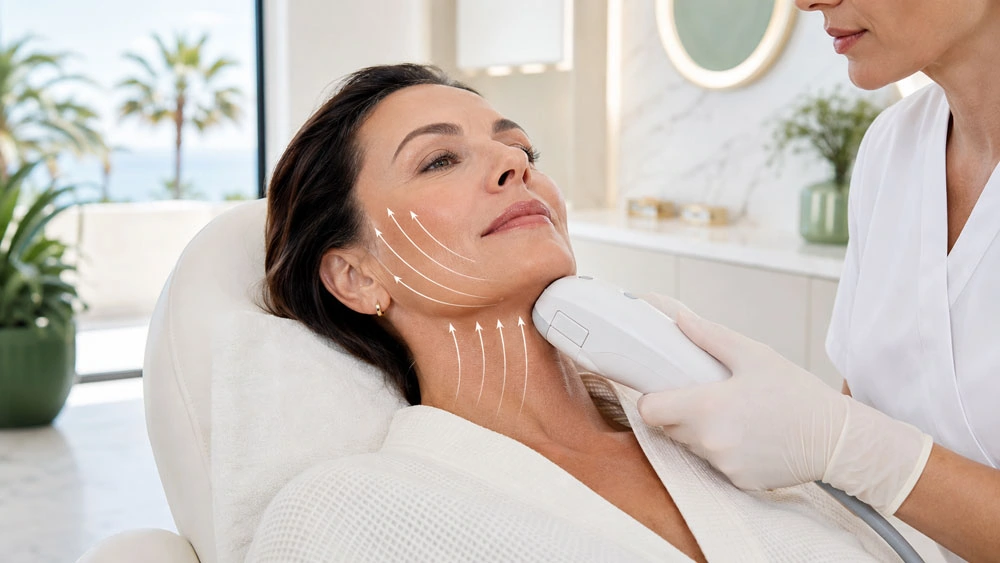
Ultherapy may be more relevant when the main concern is not expression lines, but sagging skin, loss of firmness and reduced facial definition. This is where Ultherapy / Ultraformer MPT differs from Botox: it does not relax facial muscles, but works with deeper tissue layers using focused ultrasound.
Patients often start considering Ultherapy when they notice that the lower face looks less defined, the jawline becomes softer, or the skin around the neck and under the chin begins to lose firmness. These changes are usually related to skin laxity, collagen loss and tissue support, not only to muscle movement.
Areas where Ultherapy is often considered
Ultherapy / Ultraformer MPT may be considered for:
- jawline definition;
- mild to moderate jowls;
- neck laxity;
- skin under the chin;
- lower-face firmness;
- brow area support;
- early signs of facial sagging.
This does not mean that Ultherapy is suitable for everyone. If skin laxity is severe, surgical options may sometimes be more appropriate. If the main issue is volume loss, dermal fillers or biostimulators may be discussed. If the concern is active expression lines, Botox may still be the better option.
The value of Ultherapy is that it can be part of a non-surgical facelift strategy for patients who want a natural-looking improvement without adding volume and without relaxing facial expression. At FBS Beauty in Marbella, this decision should always begin with an assessment of the skin, facial anatomy and realistic expectations.
Botox vs Ultherapy comparison table
Botox and Ultherapy are often compared because both are used in non-surgical facial rejuvenation. However, they are not the same type of treatment. Botox works mainly with muscle-related wrinkles, while Ultherapy / Ultraformer MPT is more focused on skin tightening, tissue support and facial contour improvement.
| Feature | Botox | Ultherapy / Ultraformer MPT |
|---|---|---|
| Main purpose | Softening expression lines | Tightening and lifting sagging skin |
| Best for | Forehead lines, frown lines, crow’s feet | Jawline, neck, jowls, lower face, mild to moderate laxity |
| How it works | Temporarily relaxes selected facial muscles | Uses focused ultrasound to support collagen renewal in deeper tissue layers |
| Treatment type | Injectable | Non-invasive device-based treatment |
| Works on muscles? | Yes | No |
| Works on SMAS-level support? | No | Yes, focused ultrasound can target deeper support layers |
| Helps with sagging skin? | Not directly | May help improve skin laxity and facial contours |
| Helps with dynamic wrinkles? | Yes | Not directly |
| Result timeline | Usually visible within several days | Develops gradually over weeks and months |
| Typical use in a treatment plan | Expression lines and prevention of deeper dynamic wrinkles | Non-surgical facelift strategy, skin tightening and contour support |
The simplest way to understand the difference is this: Botox is usually chosen when the problem appears during facial movement, while Ultherapy is considered when the problem is visible even when the face is relaxed. If you see lines when you smile or frown, Botox may be relevant. If you see softness along the jawline, jowls or neck laxity at rest, Ultherapy may be the treatment to discuss.
Can Botox lift sagging skin?
Botox cannot directly lift sagging skin. It can soften wrinkles caused by muscle movement, but it does not tighten loose tissue, restore collagen support or work on the deeper SMAS layer.
This is an important distinction. A patient may search for Botox because the face looks tired or older, but the visible problem is not always caused by wrinkles. Sometimes the real concern is skin laxity: a softer jawline, early jowls, loose skin under the chin or reduced firmness in the neck area.
In these cases, Botox may improve selected expression lines, but it will not correct the structural reason why the lower face looks less defined. For sagging skin, a treatment that works with tissue tightening and collagen stimulation may be more relevant.
Ultherapy / Ultraformer MPT is often discussed in this context because focused ultrasound can target deeper support layers without surgery. It does not add volume and does not freeze facial expression. Instead, it may help support a gradual tightening effect in areas where laxity is the main concern.
When Botox alone may not be enough
Botox alone may not be enough if the main concern is:
- jowls or lower-face sagging;
- loss of jawline definition;
- loose skin under the chin;
- neck laxity;
- mild to moderate facial drooping;
- skin that looks less firm even when the face is relaxed.
This does not mean Botox is a poor treatment. It means the treatment should match the cause of the concern. If the problem is muscle activity, Botox may be appropriate. If the problem is tissue laxity, Ultherapy may be a better treatment to discuss during consultation.
Can Ultherapy replace Botox?
Ultherapy does not directly replace Botox because it does not work on the same problem. Botox targets muscle-related expression lines, while Ultherapy / Ultraformer MPT targets skin laxity, tissue support and facial contouring.
For example, if a patient wants to soften frown lines between the eyebrows or crow’s feet around the eyes, Botox may be more appropriate. These lines are usually created by repeated muscle movement, and Ultherapy does not relax those muscles.
Ultherapy becomes more relevant when the concern is deeper and more structural: sagging skin, jowls, lower-face heaviness, neck laxity or loss of jawline definition. In these cases, the issue is not only the surface wrinkle, but the support and firmness of the tissue below the skin.
This is why the choice should not be made only by comparing treatment names. A proper assessment should identify what is actually causing the concern: muscle activity, skin laxity, collagen loss, volume loss or a combination of factors.
Why the consultation matters
Two patients may both say they “look older”, but they may need completely different treatment plans. One may have active forehead movement and benefit from Botox. Another may have early jowls and neck laxity and be a better candidate for Ultherapy. A third patient may need a combined approach.
At FBS Beauty in Marbella, consultation helps determine whether the main issue is expression lines, sagging skin, facial volume loss or skin quality. This is the safest way to choose between Botox, Ultherapy / Ultraformer MPT or a combined non-surgical rejuvenation plan.
Can Botox and Ultherapy be combined?
Yes, Botox and Ultherapy can sometimes be combined because they address different signs of aging. Botox may soften expression lines, while Ultherapy / Ultraformer MPT may support skin tightening and improve facial contours without surgery.
This combination can be useful when a patient has more than one concern. For example, a person may have forehead lines or crow’s feet caused by facial movement, but also notice early jowls, a softer jawline or neck laxity. In that case, treating only the wrinkles may not improve the overall facial contour, and treating only the skin laxity may not soften active expression lines.
A combined plan does not mean doing everything at once. The timing, order and suitability of each procedure should be decided during consultation. The practitioner needs to assess facial anatomy, skin thickness, muscle activity, previous treatments, medical history and expected results.
When a combined approach may make sense
A combined Botox and Ultherapy plan may be discussed when there are:
- expression lines in the upper face;
- early jowls or lower-face laxity;
- reduced jawline definition;
- mild neck laxity;
- a desire for a natural result without surgery;
- several aging signs that cannot be addressed by one treatment alone.
The goal is not to over-treat the face, but to choose the right method for each concern. When planned carefully, Botox and Ultherapy can work as complementary treatments rather than competing options.
Who may be a good candidate for Ultherapy in Marbella?
Ultherapy may be suitable for patients who notice mild to moderate skin laxity and want a non-surgical approach to facial lifting. It is often considered when the main concern is not only wrinkles, but also loss of firmness, softer facial contours, early jowls or neck laxity.
A good candidate for Ultherapy / Ultraformer MPT is usually someone who still has enough skin quality and collagen response for a non-invasive treatment to create visible improvement over time. The procedure is not designed to replace surgery in severe sagging, but it may be relevant for patients who want gradual tightening without incisions, stitches or significant downtime.
Common concerns that may point toward Ultherapy
Ultherapy may be discussed if you notice:
- the jawline is becoming less defined;
- early jowls are starting to appear;
- the neck looks less firm;
- the skin under the chin is softer;
- the lower face looks heavier or less lifted;
- the brow area has mild drooping;
- the face looks tired even when expression lines are not the main issue.
For English-speaking patients and expats in Marbella, the decision often comes down to choosing a treatment that fits their lifestyle. Many people want a natural-looking result, minimal interruption to their schedule and a clear explanation of what the treatment can and cannot do.
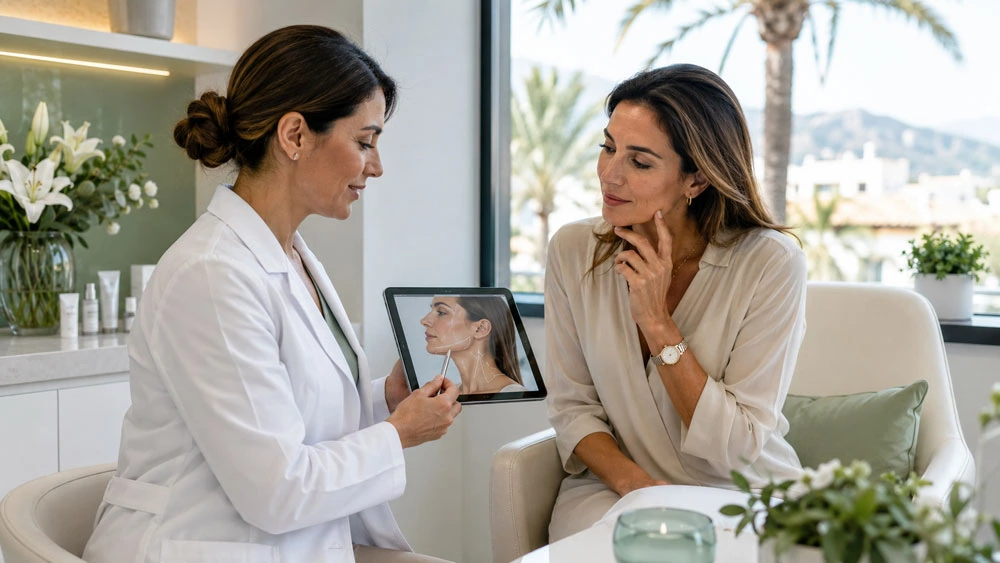
At FBS Beauty in Marbella, Dr. Olga Semenova can assess the skin, facial contours, muscle activity and medical history before recommending Ultherapy / Ultraformer MPT, Botox or another treatment plan. This is important because the best option depends on the real cause of the concern, not only on the name of the procedure.
How to choose between Botox and Ultherapy
The right choice depends on what is causing the visible aging concern. If the problem comes from repeated muscle movement, Botox may be more suitable. If the problem is sagging skin, jawline softness, neck laxity or early jowls, Ultherapy / Ultraformer MPT may be more relevant.
A simple way to think about it is this: Botox is usually chosen for wrinkles that appear with expression, while Ultherapy is considered for changes that are visible even when the face is relaxed. This difference matters because treating the wrong cause may lead to disappointing results.
For example, if you are bothered by forehead lines that appear when you raise your eyebrows, Botox may help soften the movement that creates them. But if the main issue is a less defined lower face or loose skin under the chin, relaxing facial muscles will not correct the underlying laxity.
On the other hand, Ultherapy may help support skin tightening and contour improvement, but it will not replace Botox for active frown lines or crow’s feet. That is why a good treatment plan should not start with the name of the procedure. It should start with the diagnosis of the concern.
Questions to ask before choosing a treatment
Before deciding between Botox and Ultherapy, it is useful to ask:
- Are my lines visible only when I move my face, or also when my face is relaxed?
- Is my main concern wrinkles, sagging skin, or both?
- Do I notice jowls, neck laxity or loss of jawline definition?
- Do I need muscle relaxation, skin tightening, volume restoration or a combined plan?
- What result would look natural for my face?
- Are there any contraindications or previous treatments that should be considered?
At FBS Beauty in Marbella, the consultation helps answer these questions before treatment. This makes it easier to choose between Botox, Ultherapy / Ultraformer MPT, or another approach based on your facial structure, skin condition and expectations.
Frequently asked questions
Is Ultherapy better than Botox?
Ultherapy is not simply better than Botox; it works for a different concern. Botox is mainly used for expression lines caused by muscle movement, while Ultherapy / Ultraformer MPT may be more relevant for sagging skin, jawline definition, neck laxity and jowls after medical consultation.
Is Botox good for sagging skin?
Botox is not designed to tighten sagging skin or lift the SMAS layer. It can soften dynamic wrinkles such as frown lines, forehead lines and crow’s feet, but skin laxity usually requires a different approach, such as focused ultrasound, radiofrequency or another treatment recommended during consultation.
Can Ultherapy replace Botox?
Ultherapy does not replace Botox because it does not relax facial muscles. It may help with skin tightening and facial contour support, while Botox is used for wrinkles created by repeated muscle movement. Some patients may need one treatment, while others may benefit from a combined plan.
Can Botox and Ultherapy be combined?
Yes, Botox and Ultherapy can sometimes be combined because they address different signs of aging. Botox may soften expression lines, while Ultherapy / Ultraformer MPT may support tighter-looking skin around the jawline, neck and lower face. The timing and sequence should be decided by a medical professional.
Which treatment is better for jowls and jawline definition?
If the main concern is jowls, jawline softness or lower-face laxity, Ultherapy / Ultraformer MPT may be more relevant than Botox. Botox does not directly lift sagging tissue, while focused ultrasound is used to support skin tightening and facial contour improvement without surgery.
Which treatment is better for forehead lines and crow’s feet?
Botox is usually more relevant for forehead lines, frown lines and crow’s feet because these wrinkles are often caused by facial muscle activity. Ultherapy does not relax those muscles, so it is usually considered for skin laxity rather than active expression lines.
How do I know whether I need Botox or Ultherapy?
The best way to choose is to identify the cause of the concern. If lines appear mainly when you move your face, Botox may be suitable. If you notice sagging skin, neck laxity, jowls or loss of jawline definition even when your face is relaxed, Ultherapy may be a better treatment to discuss.
Where can I get a consultation for Ultherapy in Marbella?
You can book a consultation at FBS Beauty in Marbella to discuss whether Ultherapy / Ultraformer MPT is suitable for your skin, facial contours and aesthetic goals. Dr. Olga Semenova can assess whether your concern is mainly expression lines, skin laxity, volume loss or a combination of factors.
Book a consultation at FBS Beauty in Marbella
Botox vs Ultherapy is not about choosing the most popular treatment, but about choosing the right approach for your face. Expression lines, sagging skin, jowls, neck laxity and volume loss can look similar at first, but they often need different solutions.
If you are considering Botox, Ultherapy / Ultraformer MPT or a combined non-surgical rejuvenation plan, start with a professional consultation. At FBS Beauty in Marbella, Dr. Olga Semenova can assess your skin, facial contours and treatment history to recommend an option that matches your goals and looks natural.
Learn more about Ultherapy / Ultraformer MPT in Marbella or book a consultation with FBS Beauty to discuss your treatment plan.